Camping
Snomaster Leisure 75L Fridge
Introduction
During 2022, Makro had a special on the Snomaster Leisure Series SMDZ LS75 fridge, which prompted me to buy it as it is a dual compartment fridge/freezer (this fridge is no longer part of the Snomaster range - see update below). I would have preferred a slightly smaller steel jacketed fridge, but these devices are very much more expensive than the Leisure Series fridges.
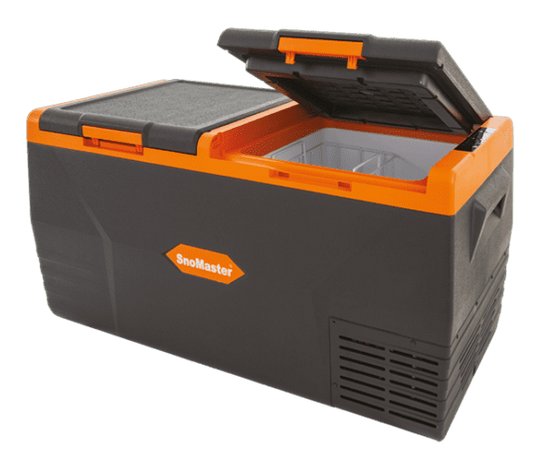
The Snomaster SMDZ LS75 fridge
The fridge casing is made from polypropylene, with cyclopentane as the insulating material between the walls (much like some of the better quality cooler boxes, such as Coleman). The top has an area of 840mm x 450mm and it has a height of 480mm. It weighs 21kg. It has moulded "handles" on the sides. These handles make it virtually impossible for two people to carry the fridge as there is too little to grip on to. Although not shown in the pic above, the newer version of the fridge has mounting/securing bolts below the handle (discussed later).
The volume of the left compartment (as shown in the pic below) is 45L, while the right one is 30L. Each compartment can be set at different temperatures and each compartment has a powder coated steel basket, which makes it very easy to pack the fridge.
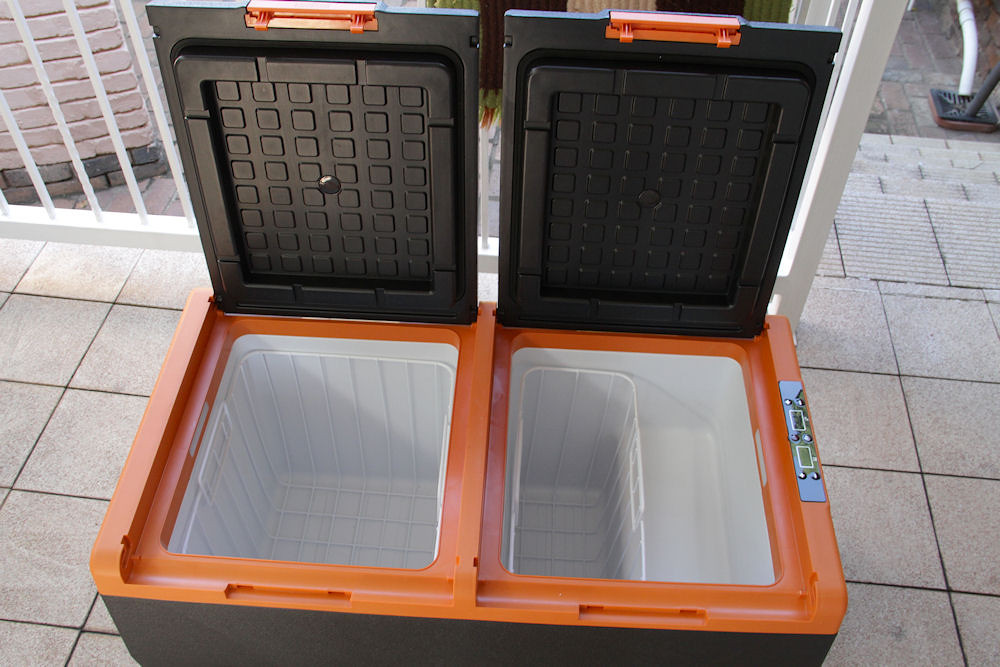
The fridge compartments, showing the baskets
The control panel is on the right of the lids in the pics above. Figuring out how to operate the controls took a bit of trial and error.
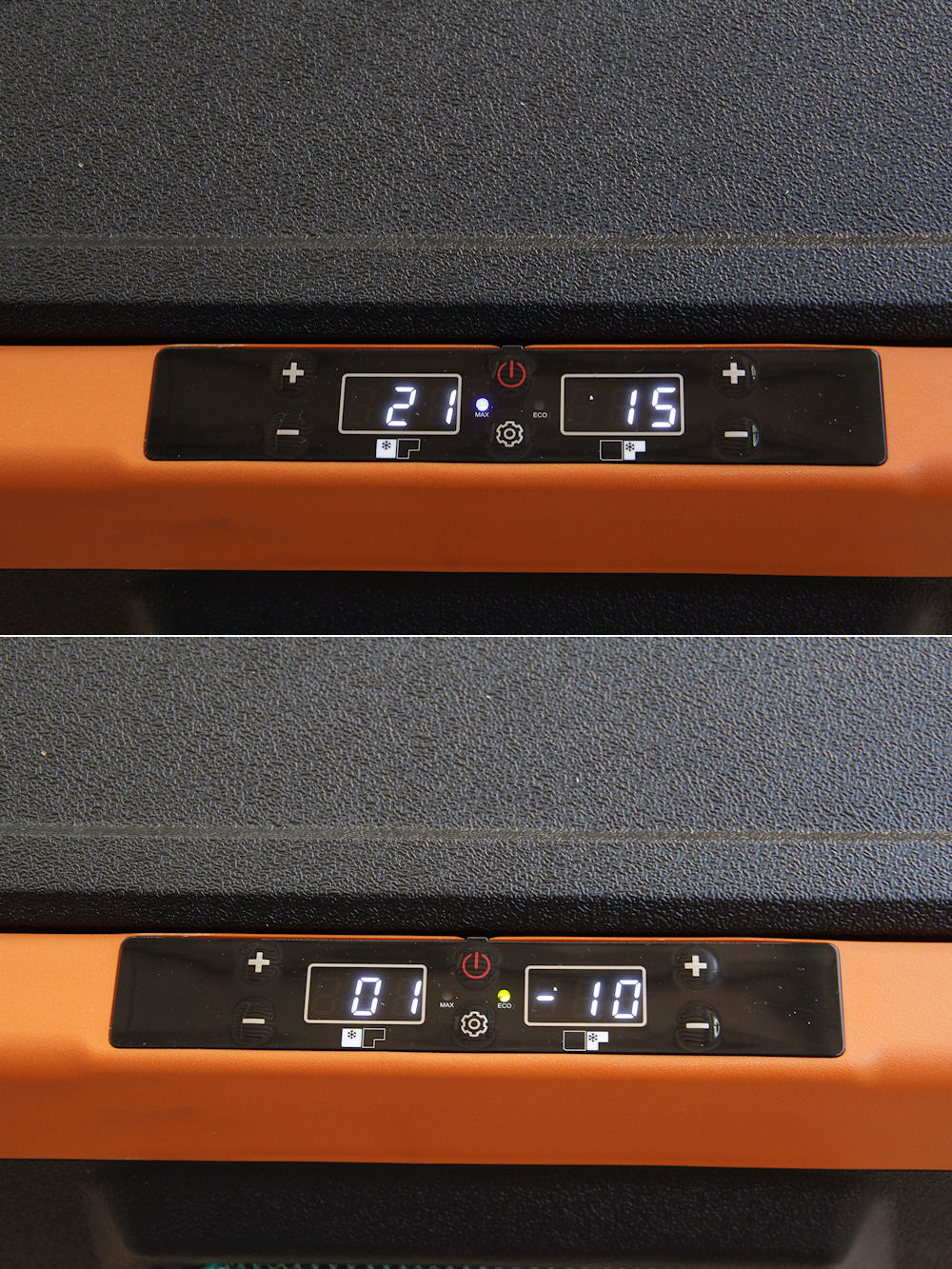
The control panel with the top pic in Max mode, the bottom in Eco mode
I normally run the fridge in Max mode (73W) until my required operating temperature is reached, after which I switch to Eco mode (43W). The readouts give the temperature of each compartment. Pressing a + or - key displays the set temperature of the associated compartment. Repeated pressing will move the set temperature up or down (I have the temperatures set at 4°C and -10°C). The control system does remember the settings after the device is shut down. The display cannot be switched off.
The lids have a rubber sealing ring recessed into the plastic. If you look at the pic below, you will see a ridge around the edge of the compartment. This fits into a groove in the sealing ring to complete the seal.
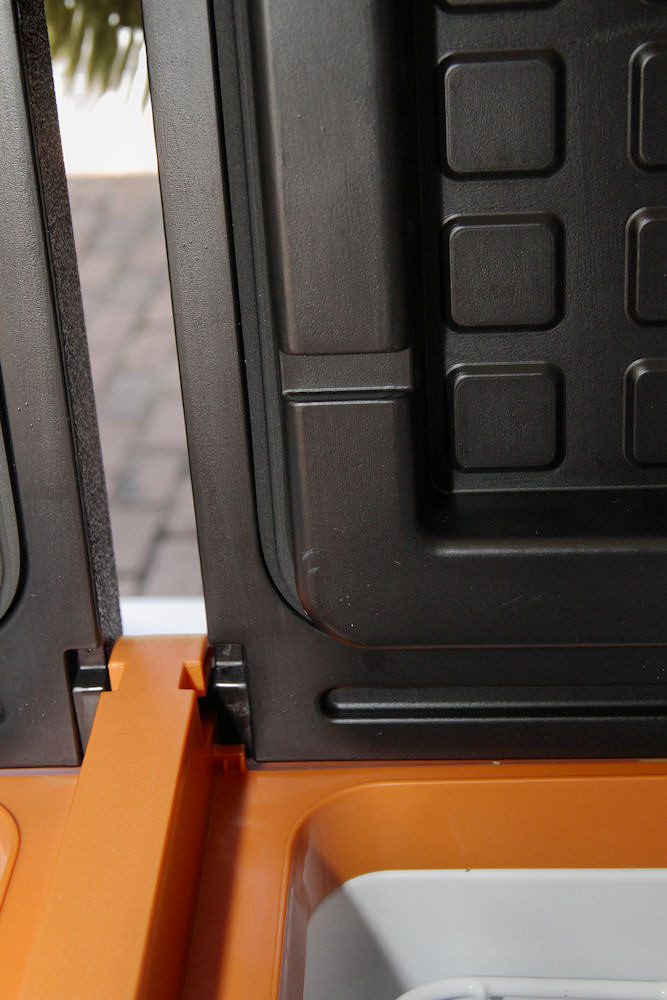
The rubber seal on the lid
The lids on the compartments can be reversed, which can help with the orientation of the fridge in the vehicle. (Link to video.)
The power cord is fitted with a cigarette lighter type plug. The AC power brick has a cigarette lighter socket to receive this plug. The cigarette lighter plug can also be changed to a Hella plug.
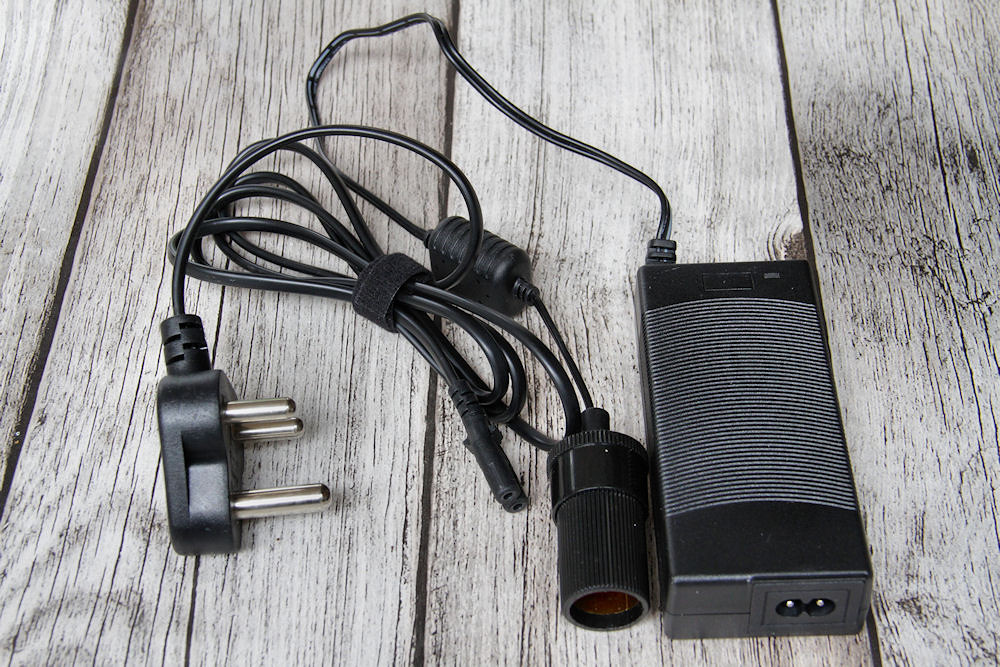
The power brick with cigarette light socket
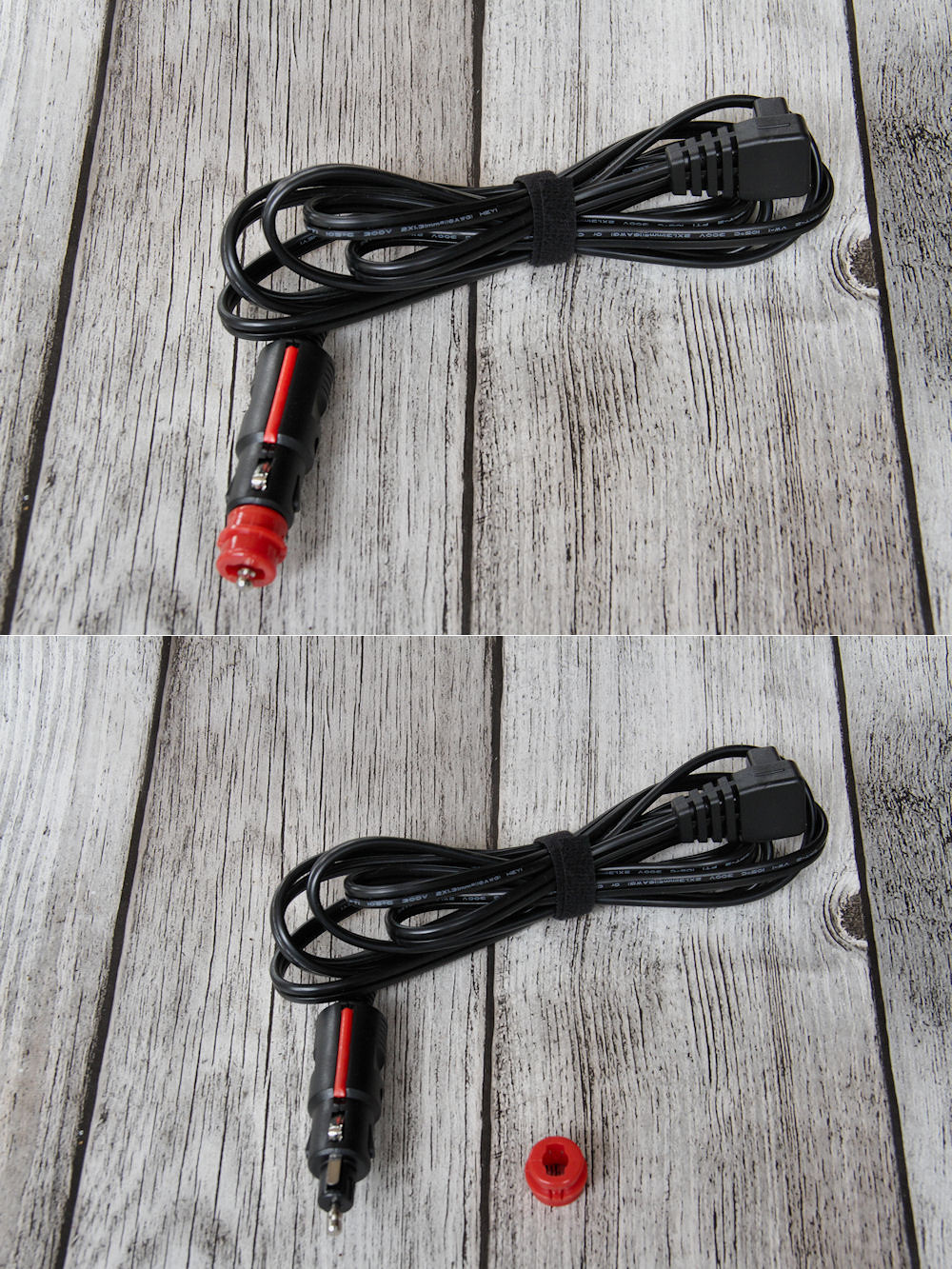
The fridge cable with the cigarette lighter plug on the top and the hella plug on the bottom
One thing that I don't like about the convertible cigarette lighter plug is that it does not fit as firmly into the socket as a standalone plug. I may replace this plug with a standalone plug once the warranty on the fridge expires. This may be a long time in coming, as the overall warranty is three years, with a seven year warranty on the compressor.
I must add here that the Snomaster support staff are very prompt in answering questions. One very important thing I learnt from them was that the fridge should be run once a month, for a couple of days, to circulate the refrigerant.
(updated: 6 April 2023)
Testing the fridge
A problem I ran into when starting up the fridge was trying to set it up to run at the temperatures that I wanted. The manual is rather vague in this respect (I have a feeling that this is probably because the manual is trying to cover three different fridge models). Fortunately, once I figured out how to set the temperature in the compartments (as mentioned above), things like "Advanced Setting" became irrelevant. I still cannot swap between C and F (not that I would want to go to F) and the "battery protection" function serves no purpose if you are running off a box like the Jackery, which has a regulated DC output. The Jackery delivers the 12V, regardless of the state of its battery.
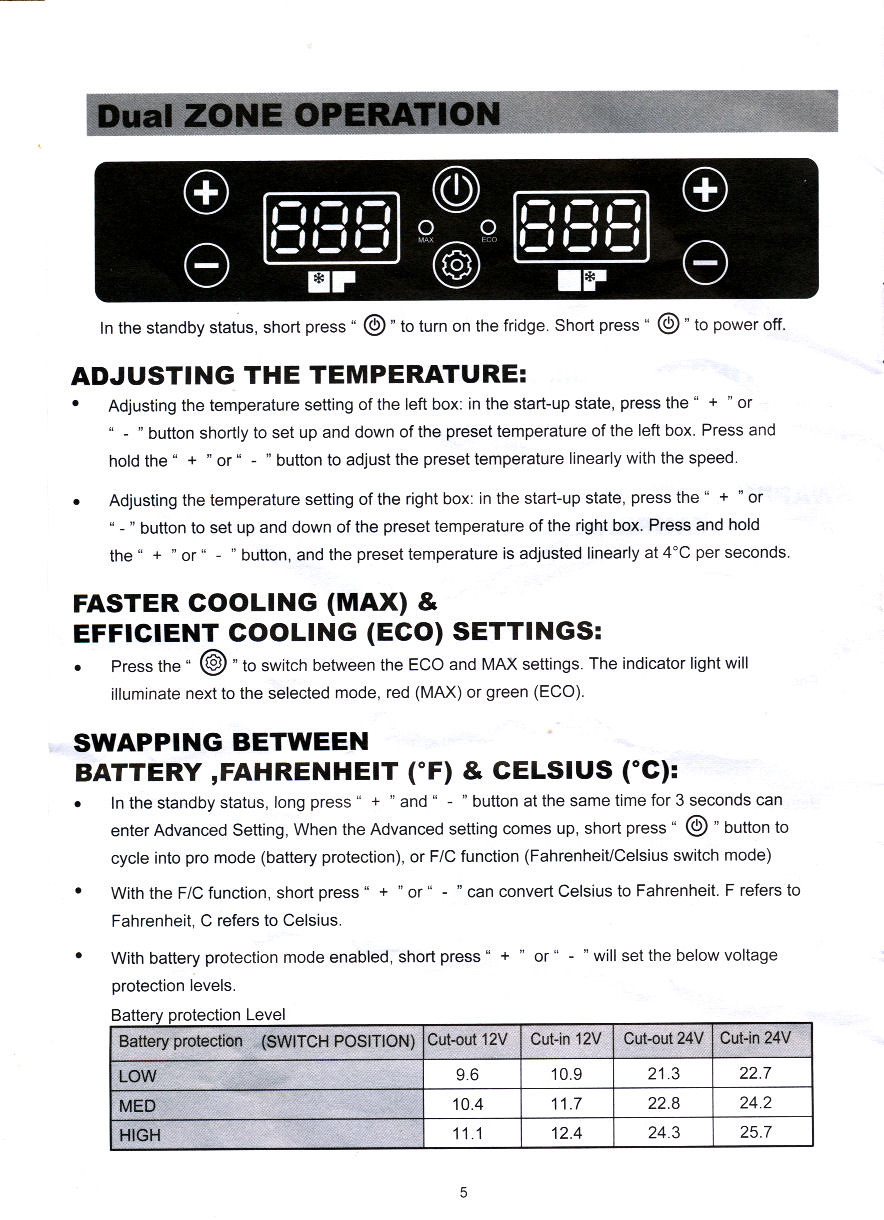
The instruction page for the dual compartment fridge
The first test was running the fridge off the Jackery. I had some frozen chicken pieces and an ice tray in the freezer section with a six pack of beer and a couple of bottles of water in the fridge section. I used the AC power brick to get the fridge compartments to their operating temperatures in Max mode. This took roughly one hour (this has been pretty consistent every time I have run the fridge, but it does depend on the ambient temperature). Once the fridge got to within a few degrees of my set temperatures, I switched to Eco mode, and connected the Jackery. On this first run, the compressor only used 24W in Eco Mode (the ambient temperature was 15°C at the time), but on all subsequent uses this has been 43W (measurements were from the Jackery's output power meter). In Max Mode, the compressor uses 73W. After 24h, the Jackery still showed 20% of its capacity remaining.
The second part of this first test was to see how the Gizzu would fare running the fridge. As the fridge was already at the required temperature, I swapped the Jackery and Gizzu around. Although the Gizzu has no digital read-out, I could follow the bar graph on the display to get an idea of how quickly the battery was being depleted. After 18h, it seemed to be doing better than the Jackery, but five minutes short of 24h running time, it switched off. I was very impressed with both boxes.
With the second test I wanted to try out the Jackery in conjunction with its solar panel. This test was a bit limited as I only had one 5m extension cable for the panel, which made placing the panel a problem. To get a decent amount of sunlight on the panel, I had to move the fridge, which as I have mentioned before is not a trivial exercise, because of the [lack of] handles, especially if there are things in the fridge. I have discussed what I found in this test on my Jackery solar panel page, but that has more to do with the panel than the fridge. I have to say however, that I was more than impressed with the way the fridge worked under these "real" camping type conditions. I was able to run the fridge for three days without using mains power.
The third test was a lot easier as I had bought a second 5m extension cable for the panel. I did not have to move the fridge in order to be able to move the panel. The results were very similar to that of the second test.
I was happy that with decent sunlight, I could keep the fridge running for more than three days with just the Jackery and its solar panel.
(updated: 16 April 2023)
It is a Camping fridge!
The first time we were actually able to use the fridge for camping was towards the end of February 2023. All our plans to get out towards the end of 2022 was scuppered by the passing of Ray and Zeke shortly after each other, and then Squeaky's illness was something we could not leave her to deal with without us. The weather after that was also against us. February 2023 was one of the wettest months that we had experienced in a long time (almost 300mm of rain in our suburb in the first three weeks). When the rain seemed to have stopped, we decided to do a trip to Ruah Park. We did have lovely sunny weather during most of our time there, but the lack of shade was not ideal for our fridge tests. Unfortunately, I was very lax in taking pics for documentation purposes, but I will post some related before our trip to Eden Park.
While we were preparing and packing to leave, I ran the fridge from mains for about 12h (empty) to cool it down and to check that everything was ok (probably overkill as an hour is good enough). Just before leaving, we packed the fridge and then connected it to the Jackery. By the time we stopped at the campsite, less than 2% of the Jackery's battery capacity had been used.
With the weight of a packed fridge, it is very difficult to move, so our plan was to leave it in the bakkie, with the Jackery which had to run it while the Jackery was being charged from [we hoped] solar.
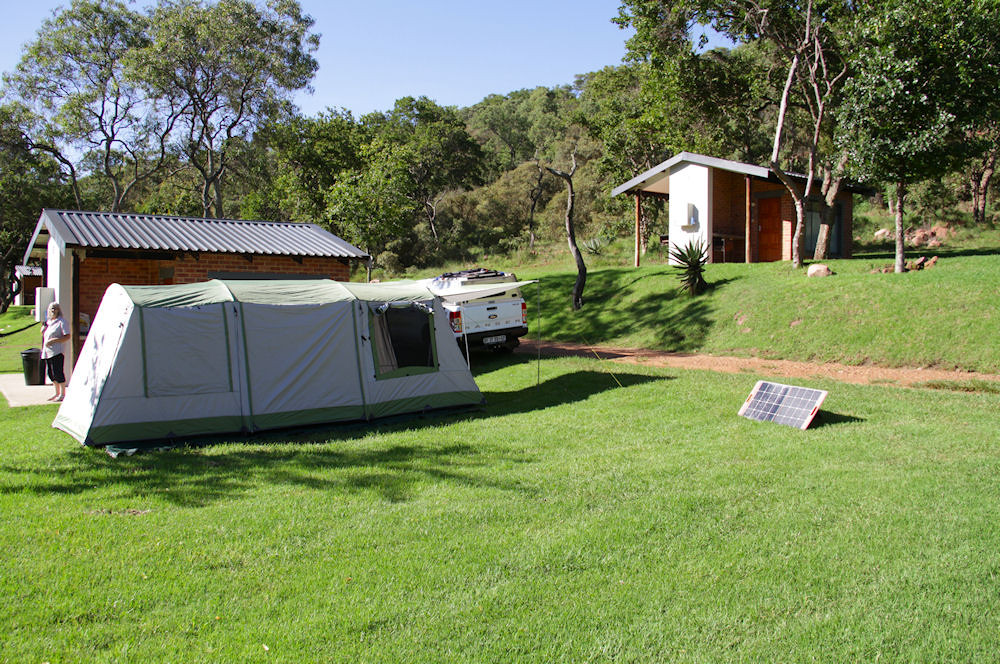
Solar panel charging Jackery while it was running the fridge
In the pic above, I had parked the bakkie in the only shade available in the vicinity of our campsite, and this after 16:00! Here you can see the advantage of having more than 10m of extension cable for the panel.
On day one, because we were setting up camp, I left the bakkie where I had originally parked it, which was roughly where the solar panel is in the pic above. I did connect the solar panel before we started pitching the tent. As you can see, there is NO shade where the panel is set up.
Although the panel provided enough power to run the fridge for the first day, because of the temperature inside the loadbox area of the bakkie, the compressor spent more time running than my tests at home (at home, the compressor was mostly off; at Ruah, it was mostly on during the day). To take some strain off the Jackery, I decided to run the fridge off the mains when load shedding allowed.
Another thing that I found was that even though the canopy only has two smallish windows, the sun shining through these onto the fridge had a serious impact on the temperatures in the two compartments. I got around this by hanging a towel over the windows. The lids of the fridge are black, and these got very warm from direct sunlight. I have since tried to minimise this heating, by putting a piece of polystyrene on each lid and stuck these down with Prestik.
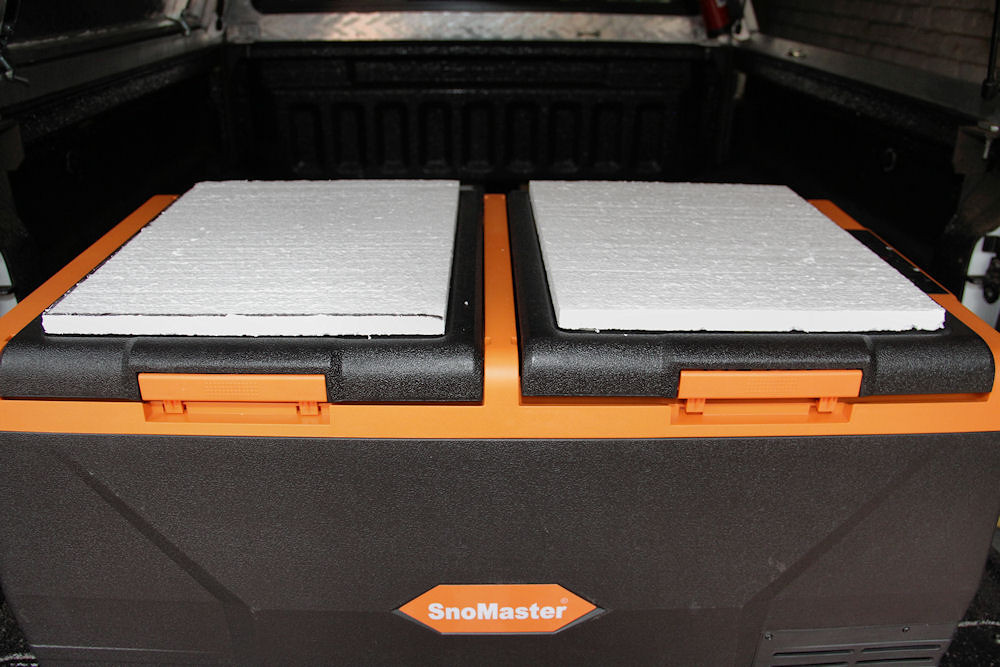
Polystyrene inserts on the lids of the fridge
Although the fridge battled to maintain the set temperatures during the day, I was more than happy the way it and the Jackery performed during our stay at Ruah.
(updated: 22 April 2023)
It is a Camping fridge (part 2)
This section maybe should have come before the previous one, but I thought showing real world use of the fridge first would help in thinking about the problems with using a fridge while camping.
What we did first off was to add usable handles to the fridge. I used ski rope with a piece of hosepipe over it to make it easier on the hands when carrying the box. The mounting bolts are Torx bolts, and fortunately I had a set of these wrenches as all the bolts in the load box of the bakkie are Torx bolts.
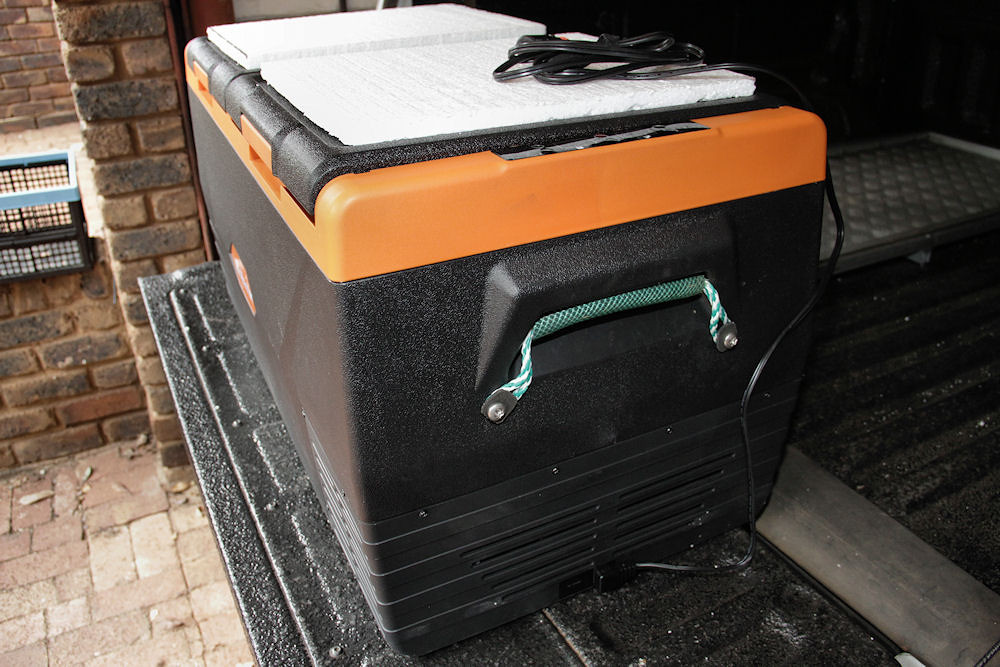
New handle
I would have liked to have used thicker rope, but the bolts were just too short to use in conjunction with my homemade rubber washers.
One thing you have to think of is where you are going to keep the fridge during your trip. Mine was a no brainer, it had to stay in the bakkie. For the fridge to function properly, you have to decide on the placement of the compressor vents on the fridge. I decided on these vents had to be on the cab side of the load box as I have a vent in the canopy on the same side (this vent doubles up nicely as a conduit for electrical cables to the Jackery when camping). In order to have free flow of air around the vents to the fridge, I made this wooden C-piece to keep the fridge from moving to the front end of the load box when braking.
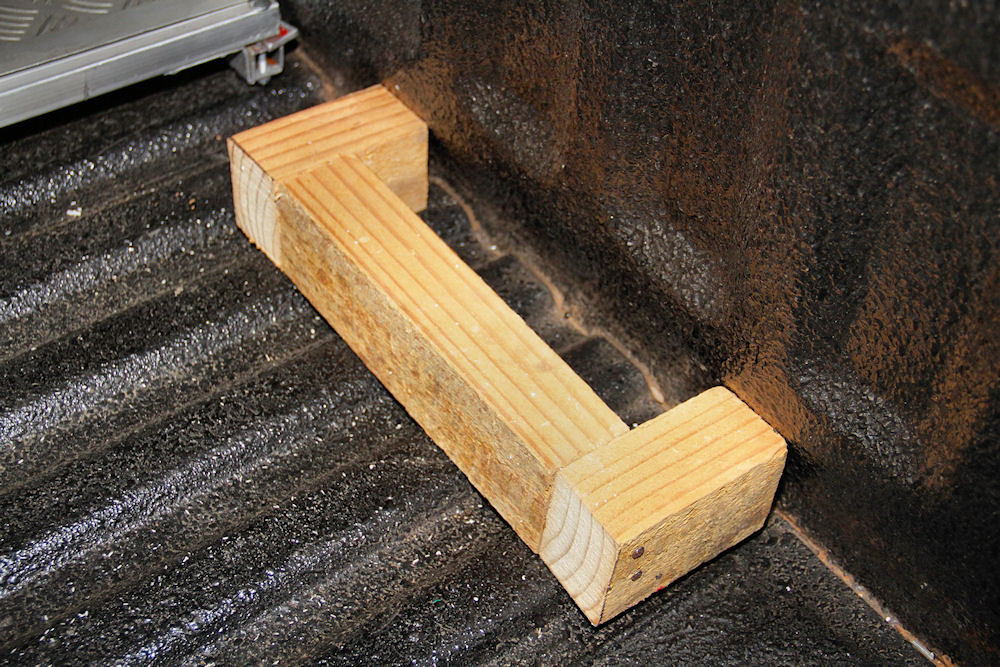
C-Piece to stop fridge from moving towards the cab
As you can see from the pic above, there are corrugations in the floor of the load box. I had to find some way of preventing the fridge from wobbling into these corrugations while travelling. Pat came up with the novel idea of using the polystyrene base from the packing material in which the fridge was shipped.
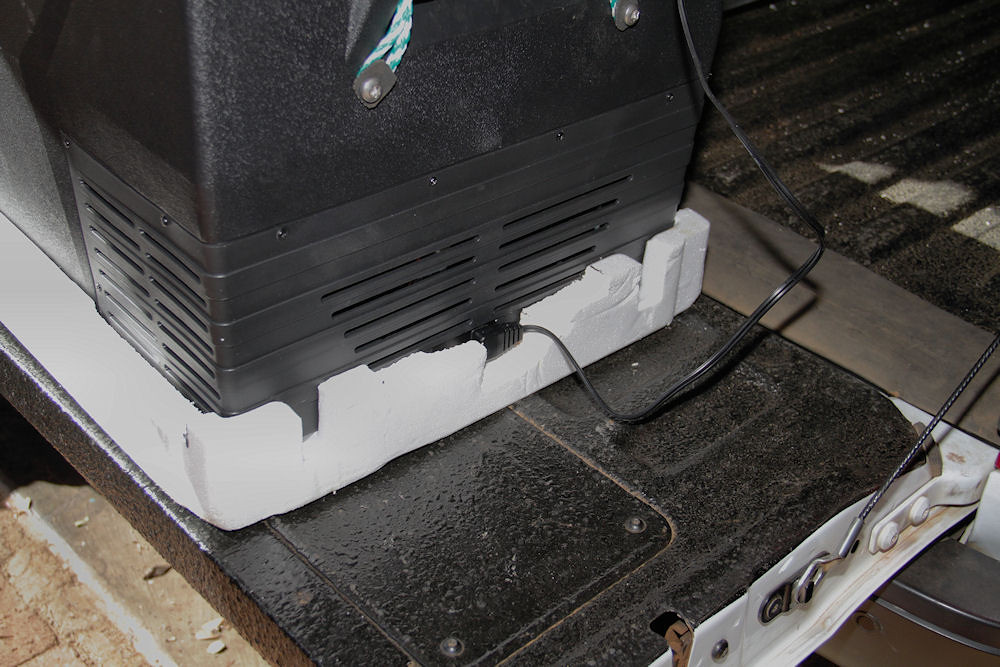
Polystyrene base for the fridge
This polystyrene base has the added advantage that the fridge slides very easily over the rubberising in the load box. The polystyrene was trimmed to allow air flow access to all the vents on the fridge, as well as the plug socket.
Here the fridge in position and tied down. I added two handles to the frame of the canopy to use as tie-down points.
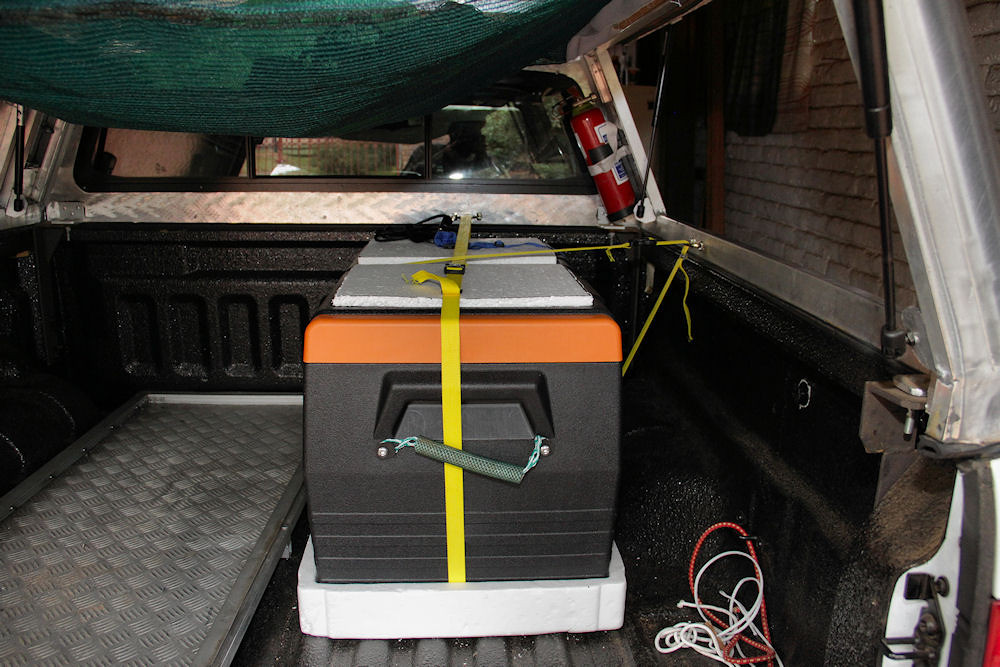
Fridge in position
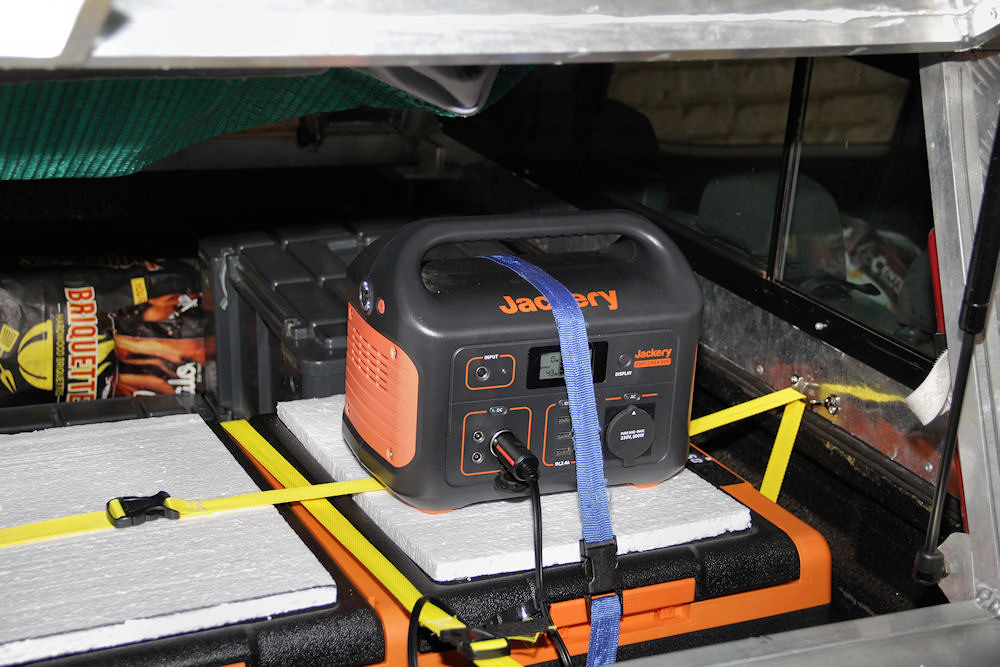
Jackery in position
Finally, the bakkie packed with the Jackery tied down and running the fridge.
(updated: 24 April 2023)
Concluding Remarks
The fridge does take strain if the temperature of its surroundings is on the high side. It does perform very well with decent shade.
(updated: 24 April 2023)
Update
Snomaster removed this fridge from their product list during 2023. Recently, while browsing a Makro catalogue, I came across a Campmaster fridge which looks almost identical to the Snomaster SMDZ LS75.
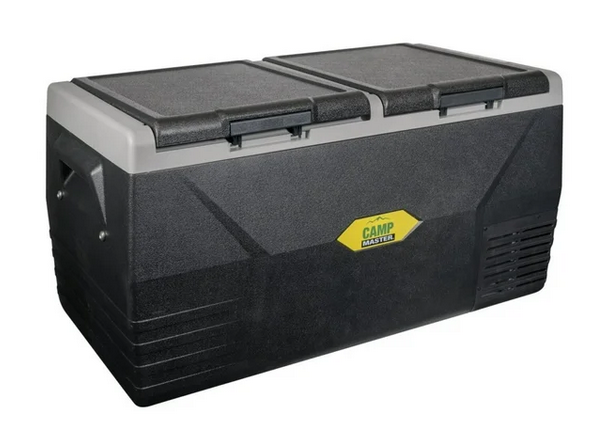
Campmaster 75L fridge
Now I am not sure whether Snomaster has sold this design to Campmaster, or this is a generic Chinese camping fridge!
(updated: 23 December 2023)
Back to Camping Gadgets
