Portable Power Supplies
Introduction
Currently, the power utility in South Africa, Eskom, is in dire straits, unable to meet the power requirements of the country. To overcome this, a system of "planned supply interruptions" is used to balance the load on the country's electricity network. This is called "load shedding". When Eskom's power stations cannot meet the electricity demands, it is up to the municipalities to ration power to users. This is done through a staggered, rotational cutting of power to users. This can be especially irritating during peak hours. We are ok for cooking as we are campers, and have enough portable appliances for that. Things like an Internet connection, computer and TV require electricity, so if you want to use these devices, you need a secondary source of electricity. For this, I looked at a portable power supply. Unfortunately, this was not as straightforward as it sounds.
A secondary goal for the portable power supply was that it should also be able to power a camping fridge for a reasonable length of time. This meant the absolute minimum battery capacity should be 500Wh. Lead acid systems were out of the question due to their weight - I wanted something that could easily be moved from my bakkie to the house (and vice versa).
As things would have it, I ended up looking at several boxes, as they did not perform up to their specifications. The biggest problem I found is that the claimed battery capacity was way off the given value.
My test setup was simple, but real-world, not like some of the things that you see on you-tube. My "test bench" was an oldish Sony TV, a Xiaomi Mi-box and a Hisense 2.1 sound bar. According to my Geewiz power meter, this lot draws 157W. I would then time how long my test devices would run off a fully charged box, until it switched off (this seems to be around 10% residual capacity).
Please note that I paid for all these devices. Those that did not match the manufacturers specifications were returned within the suppliers refund window.
Powering the Internet (Mini DC UPS - POE-431P 8800mAh)
Part of the exercise was to have an active Internet connection during load shedding (with the hope, of course, that there was power on the other end of the connection). As my fibre link is in my study, which is as far as you can get from the TV in my house, I wanted a power source independent of the box powering the TV, as I did not want extension cables running all over the house (and up a flight of stairs). I also wanted an Internet connection for mobile devices when not using the TV. Francois recommended this device as he had installed one at Jan and Marcelle's guest house and it worked very well at supplying an Internet connection to the guests during load shedding.
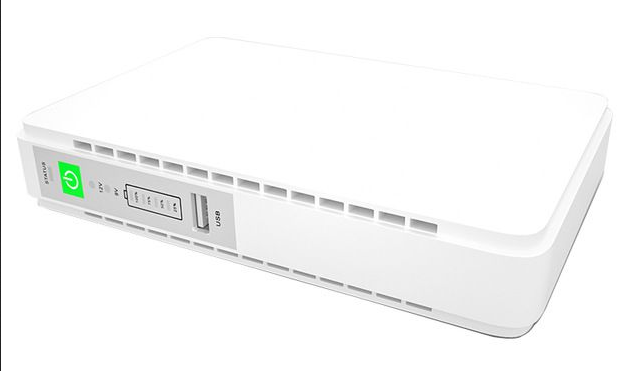
The Mini DC UPS
The device does come with a splitter cable, but the total length of this cable is about 15cm. My router is a quite a bit further than that from the fibre ONT device, so I had to find an extension cable. Like most things, it is not trivial to find things like this in South Africa, but I found one on Geewiz, however, it gave no information on the size of the connectors. I bought it anyway, as most of the reviewers on Geewiz used it in exactly the same way that I wanted to, so I had to assume that the cable's socket and plug fitted that of the router.
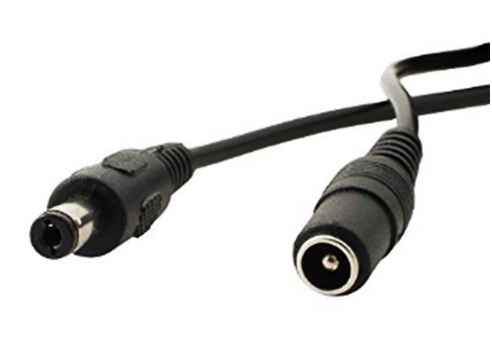
Extension cable plugs
One thing I had to do was to up the voltage from 9V to 12V to get it to drive the router with the extension cable fitted. Even though the ONT is rated at 12V, it was quite happy to run with 9V, so increasing the voltage wasn't really an issue. If the voltage is a problem, a better device might be something like the Gizzu Mini UPS as it has two separate ports which can be individually configured to run 9 or 12V.
The box has been running for two months continuously, and I have had no problems with it. During a two hour load shedding session the device loses one bar on its charge gauge, which is really impressive. The power draw on mains is 32W while charging and 8W while running the ONT and the router.
During the current round of load shedding, the price has gone up by a staggering 137% (from R549 on 1 June 2022 to R1299 on 26 July 2022). This is price gouging at its best. In view of this, I definitely would not recommend this box.
Update: (4 October 2022) During the current round of load shedding (Sept and Oct 2022) this box had a very tough test of its capabilities. On 18 September 2022, load shedding was pushed up to stage 6. On this particular day we had two four hour sessions, with four hours of power between. The box performed admirably. After the first session, the charge indicator on the box had dropped to two bars. After the second session it dropped to one bar, which was flashing, so I assume it was about to switch off. This probably means that it hadn't been able to fully charge in the four hours after the first session.
Update: (28 March 2023) The battery in this UPS took some serious strain during the load shedding cycles of December 2022 and January 2023. It can no longer last through a four hour session of load shedding - it switches off after about three and a half hours.
Update: (2 June 2023) Unfortunately, the load shedding has hurt the battery in this box quite badly. After almost exactly one year of use, it can only deliver power for just over two hours.
(updated: 7 June 2023)
Powering the Internet Part 2 (Mini DC UPS - Netogy UPS-100PLUS 14400mAh)
With the decline in the battery capacity of the POE-431P, I needed to find a replacement box to keep the Internet running. The Netogy UPS-100PLUS popped up in one of the advertising emails in my inbox. It had a higher capacity than the POE-431P, a LiFePO4 battery, and the reviews on Takealot were overwhelmingly positive, so I decided to try it.
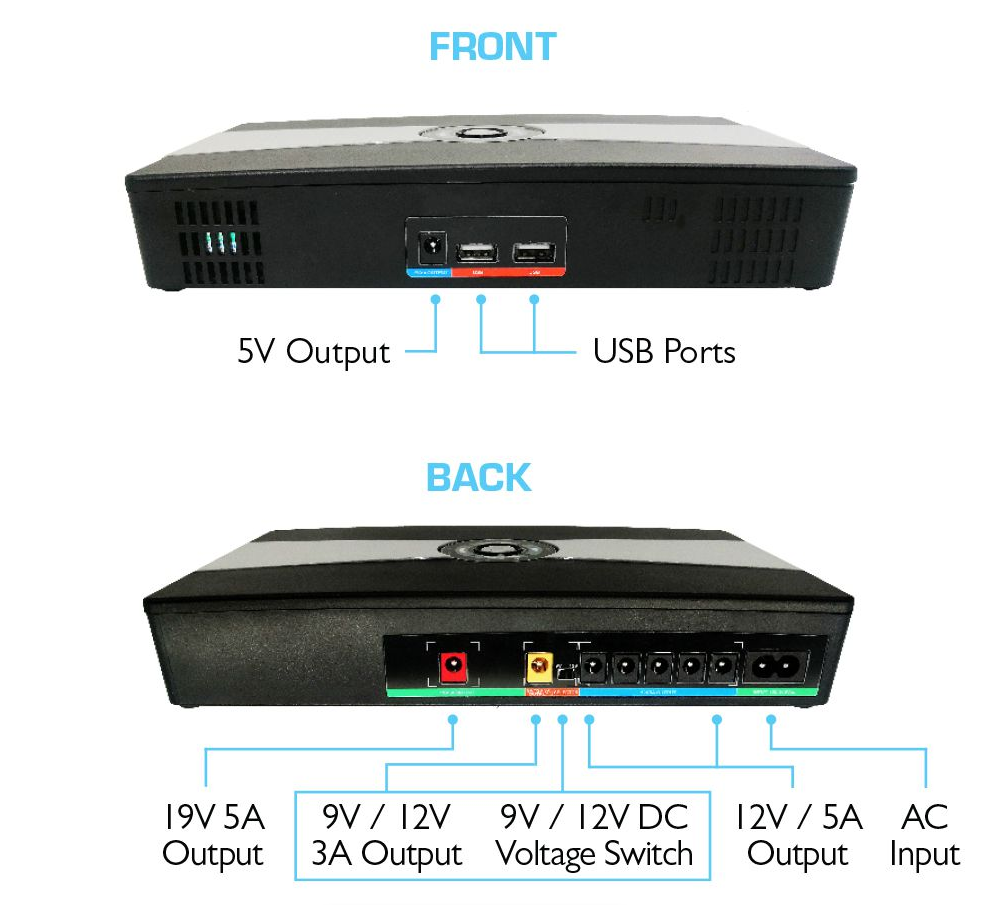
Netogy UPS-100PLUS
I have used a slightly different type of promotional image here to show the number of output ports on the box. As it has a maximum power output rating of 100W, these may be very useful depending on your need. The rated capacity is 50Wh. According to the promotional blurb, this device has 8x1800mAh batteries in it. What is a little worrying, is that all the references I can find to 1800mAh batteries are for Lithium ion and not LiFePO4 batteries.
Compared with the POE-431P, this device is huge, it is almost the size of a netbook, whereas the POE-431P is more the size of a cellphone power bank. It is also quite heavy, probably because of the LiFePO4 battery.
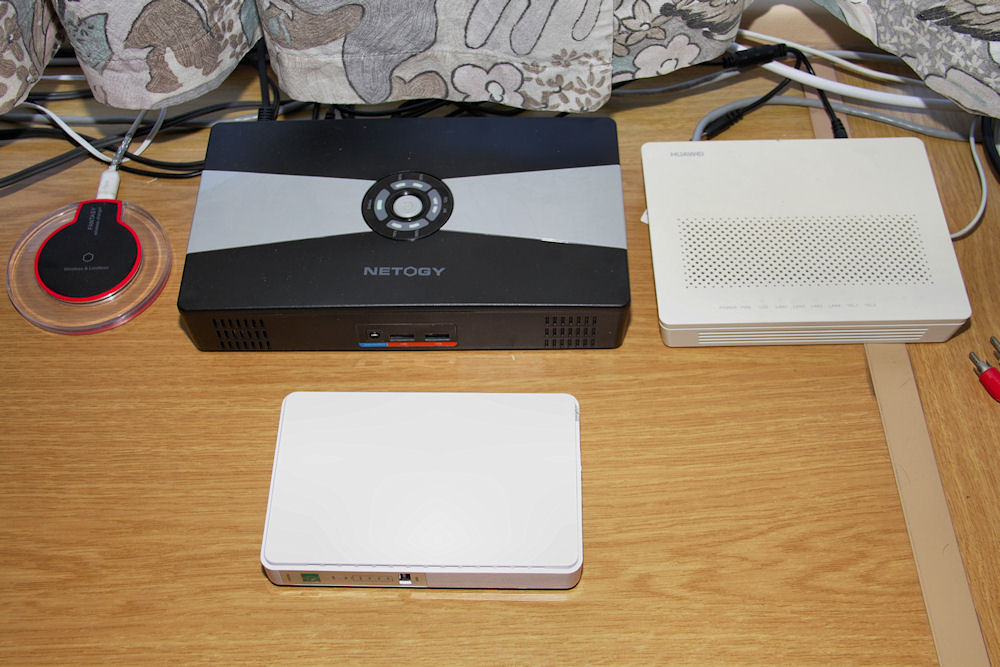
A size comparison: Netogy UPS-100PLUS, Huawei ONT and the POE-431P
As my router actually requires a 9V input (not the 12V I was using on the POE-431P), I plugged it into the 9V port and this has run without a hitch. The fibre ONT uses 12V and that is also running without any problems.
As luck would have it, after I installed the device, we had no load shedding for five days. So in order to test the device within the Takealot money-back return window, I disconnected it from mains. The first bar (75-100%) disappeared within 45 minutes, which is very much quicker than I expected. However, when I stopped the test after 200 minutes, the second bar (50-75%) was still on. So I am happy to say, this box looks as though it will be able to handle four hour load shedding sessions with ease.
We recently had a 4½h power outage due to a substation trip. During this time I had more time to see how the box performed. It followed the same pattern as my previous test with the first bar disappearing within 40 minutes. The second bar disappeared after about 235 minutes, which is very pleasing. The third bar was still on when the power came back. I didn't pay too much attention, but it did look as though the box was fully charged after about 3h which is quicker than I expected.
Update: 13 July 2023 The same substation tripped today, and this time I tracked the usage on the Netogy more closely: the box shut down after slightly more than 5½h, which I am happy with.
(updated: 13 June 2023)
Ecoflow River Max (576Wh)
The Ecoflow River Max is an Ecoflow River (288Wh) box with an extension battery added to take it up to 576Wh battery capacity. It is a really well designed device having a useful number of output ports for AC (220V) and DC (both 12V and cellphone charging ports). The input ports are 220V AC (standard kettle plug) and 12V (with adaptors for both solar and car cigarette lighter). Charging is very quick with the Ecoboost enabled. The companion app allows you to control the device from your phone, although it does require creating a user account with Ecoflow in Hong Kong. It has UPS functionality which is more than adequate for a power failure when running a TV, which makes it ideal for load-shedding.
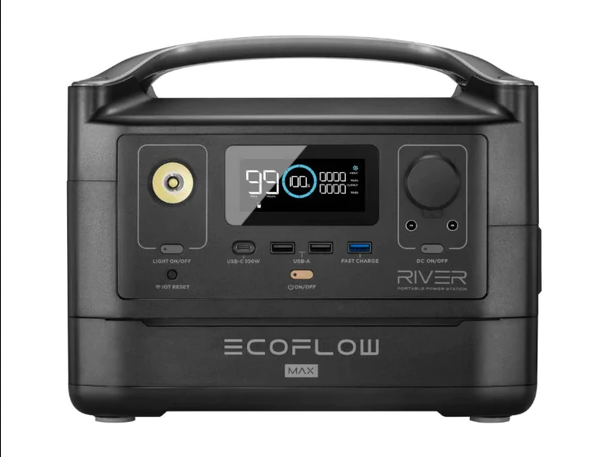
The Ecoflow River Max
However, the device does not measure up to the rated battery capacity. The first unit I had delivered less than half of the claimed 576Wh (under 2h at 150W) which makes me believe that one of the battery banks was not working. The replacement unit did marginally better at 2.5h with the output device drawing 160W. At 160W output, the batteries should last for 3.6h.
With the second box I took screenshots of the power usage from the app, at regular intervals. From this I was able to draw a graph of the power consumption.
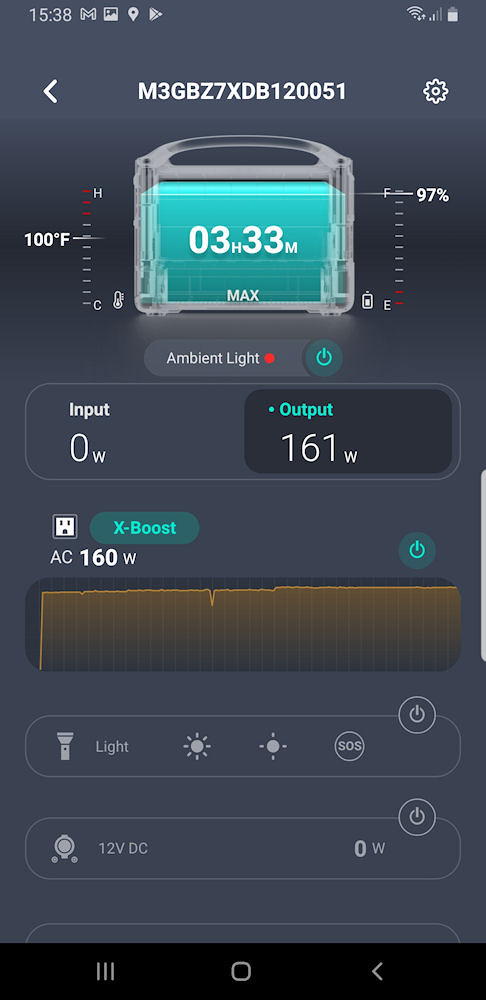
Screenshot from the app
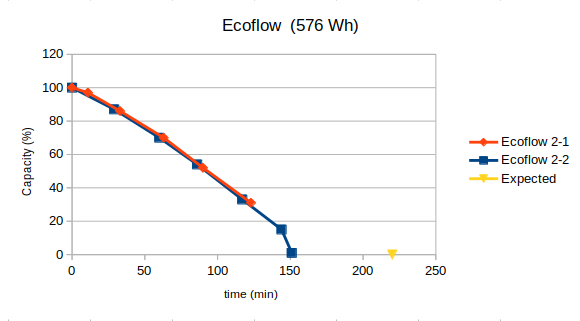
Power usage on the second Ecoflow
To summarise, here is what I found. Although the first box showed a power consumption of 150W and the second 160W, I used the 157W from the power meter.
First Box
- Expected run time: 3.7h
- Achieved run time: 1.9h
- 51% of rated capacity
Second Box
- Expected run time: 3.7h
- Achieved run time: 2.5h
- 68% of rated capacity
In spite of all the nice to haves on the Ecoflow (the short charging cycle being a major one), the battery life on both units was very poor. If the device is supposed to deliver almost four hours of power to my test system, for the price, I expect it to do so.
Update: 3 April 2023 I am not the only person in the world to have problems with the capacity of the Ecoflow River Max. Recently, Steve Conaway reporting on Cnet found that it only delivered 425Wh, which is 73% of its rated capacity.
(updated: 3 April 2023)
Gizzu GPS500 (518Wh)
Francois brought this device to my attention a couple of weeks after I had returned the second Ecoflow. I was willing to give it a try as the price was just a bit more than half that of the Ecoflow.
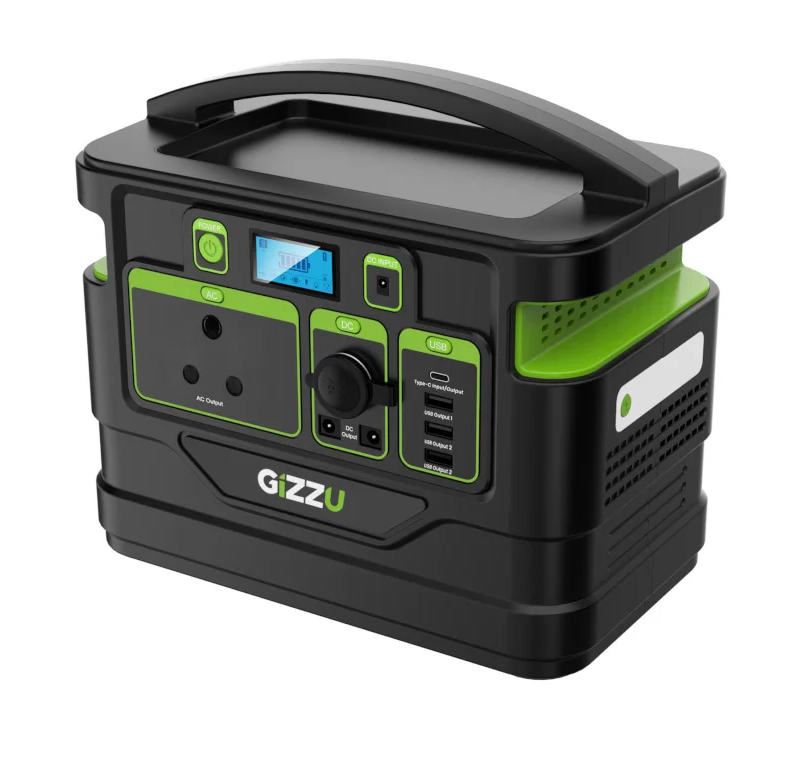
The Gizzu GPS500
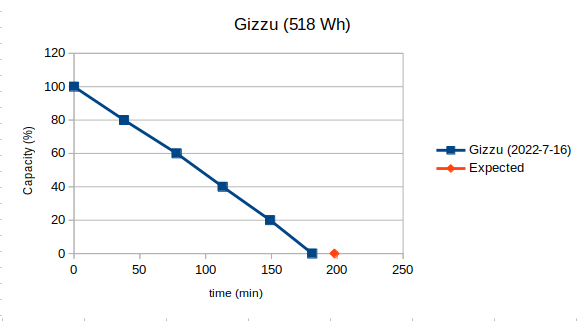
The Gizzu performed admirably. On my first run, the battery lasted 3h, which is very close to the 3.2h expected for a 157W load. One thing that was quite irritating was that the fan cooling the inverter was quite noisy.
In order to get a graph of the power usage on the Gizzu, I had to be creative, as the only power indicator is a five line bar graph, which means 20% difference between each bar. From my first test run, I knew the battery lasted three hours and 20% of three hours is 36 minutes. Using this, I could calculate the time when each bar would disappear. Using a lamp next to the display, and a pair of binoculars, I would look at the display around the expected time, then note the time when the bar had disappeared. The graph below shows I was not too bad in my timings, as it is pretty linear.
Power usage on the Gizzu
Results
- Expected run time: 3.2h
- Achieved run time: 3.0h
- 91% of rated capacity
Irritations:
- a very long charge time - it took almost 8h to charge from mains. As the power brick only draws 60W, it is easy to see why it will charge very slowly;
- the display is very primitive - only a bar graph and a few meaningless pictograms (I hate pictograms);
- no solar adaptor. I have been unable to source a 4mm barrel plug in SA, so I can't even build my own adaptor;
- there are no lights on the power buttons, and, as I have said, the pictograms are meaningless, so there is no way of knowing if any of the outputs are active;
- as mentioned above, the inverter fan is very noisy. However, with oom Ferdie's TV and Dstv decoder box, the power usage is only 87W and with that load the fan does not switch on.
In spite of these shortcomings, I kept this unit. However, the price on this device went up by R2000 in four weeks, during the current round of load shedding. Again, this is price gouging.
Update: (4 October 2022) I have since sold this device to Ferdie. He is very happy with it.
After chatting with Michael over a beer about these devices, he also bought one. He said you must monitor the prices and wait for the dips. He managed to get one for under R7000. Like Ferdie, he is very happy with it. Liz is so happy with hers, she bought a second one!
(updated: 4 October 2023)
Red-E Portable Power Station (614Wh)
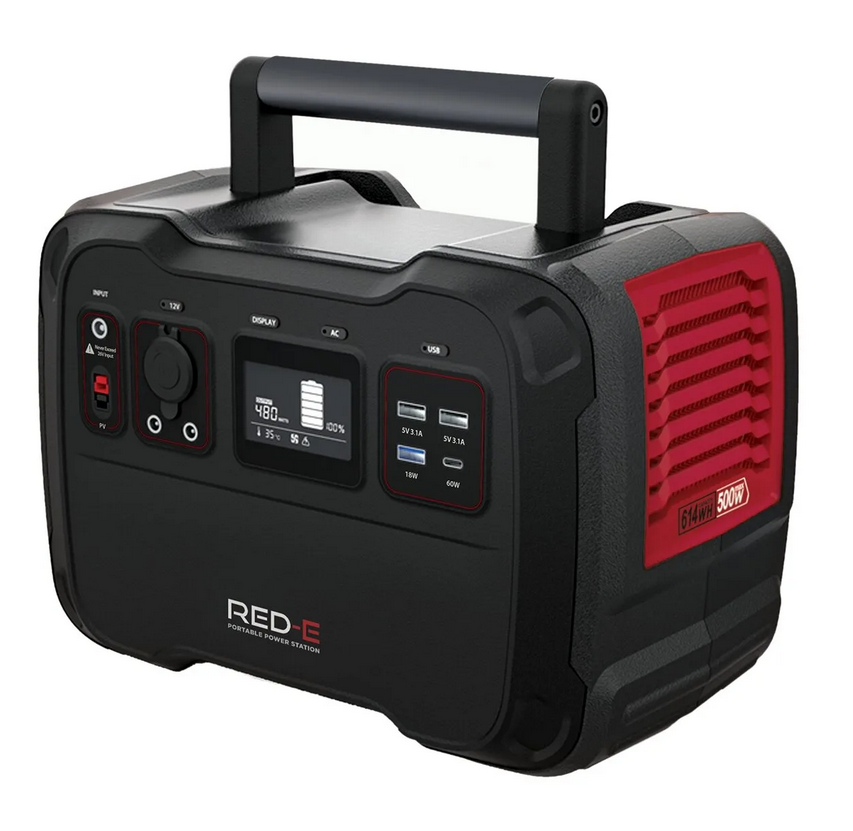
While browsing camping gadgets at Outdoor Warehouse, the salesman brought the Red-E box to our attention. What attracted me to this unit is that it is the only one I have found with a LiFePO4 battery. All the others have Li+ batteries. The chemistry of the LiFePO4 battery is said to give a much longer recharge/discharge cycle lifetime.
The Red-E
Of the devices I have tried, this one is the only on with a foldable handle. Believe it or not, this is a plus point when trying to pack one of these portable power supplies. The display gives useful information, but as with the Gizzu, the inverter fan is quite noisy. It does have a solar panel adaptor from a red/black Anderson plug to MC4.
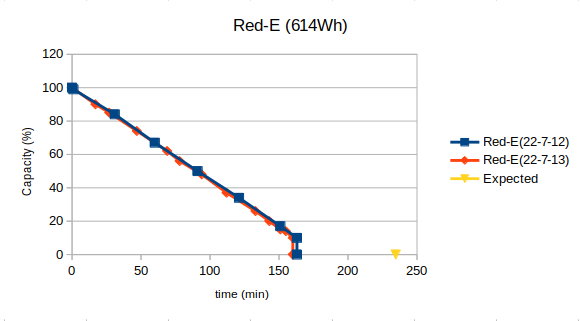
Power usage on the Red-E
Results
- Expected run time: 3.9h
- Achieved run time: 2.7h
- 69% of rated capacity
The charge times were quite long (about 6.5h), but not as bad as the Gizzu. The box drew 110W while charging.
Unfortunately, this device was way off its rated battery capacity, so it was also returned.
(updated: 13 July 2023)
Jackery Explorer 500 (518Wh)
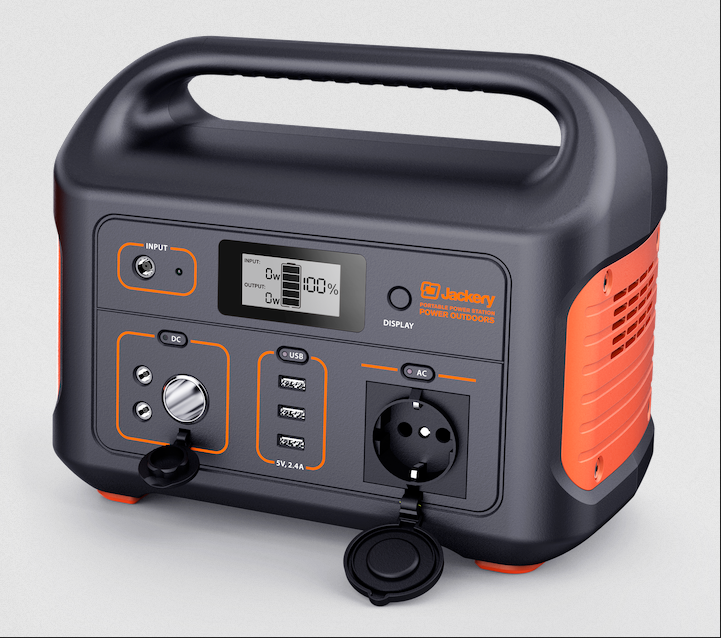
Although I feel the Jackery is overpriced, I decided to try it out, even though it was R1000 more expensive than the Red-E. One very important factor in the Jackery's favour, is that since Jackery products have been around for a while, there are many accessories available. These include Jackery 8mm (DC7909) barrel plug to Anderson connector and 5m extension cords for their solar panel (DC7909 male on one end and DC7909 female on the other). Like the Gizzu, only one port is available for charging, and no adaptors for solar are included.
The Jackery Explorer 500
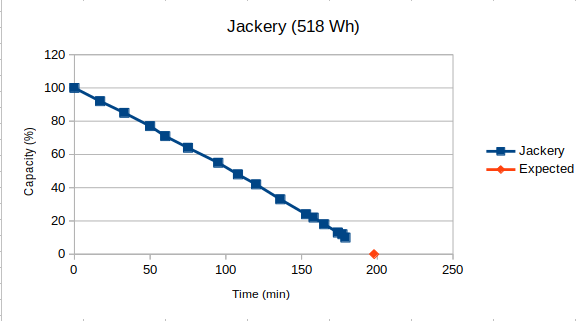
Power usage on the Jackery Explorer 500
Results
- Expected run time: 3.2h
- Achieved run time: 3.0h
- 91% of rated capacity
What should be noted here, is that although the numbers look the same as the Gizzu, the Jackery started flashing the display when the device reached 10% of remaining capacity. I shut the device down at that stage. With the Gizzu, it shut down automatically. As you can see from the graph, the curve would have hit zero almost exactly on time. This box is a keeper.
The charge time of just more than 6h is similar to that of the Red-E. It drew 100W while recharging from the mains (and shows 88W on the display), so is appreciably quicker than the Gizzu.
Update (19 January 2023) I recently bought a Jackery Explorer 500 for Jeanie. She wanted the Gizzu 518Wh, but these are currently unavailable, so I convinced her to rather buy the Jackery. I think the Jackery would be better suited to her needs, especially with the LEDs on the switches. Ferdie does battle with the Gizzu as to whether the switches are on or off.
I did test the box to see how it compared with mine.
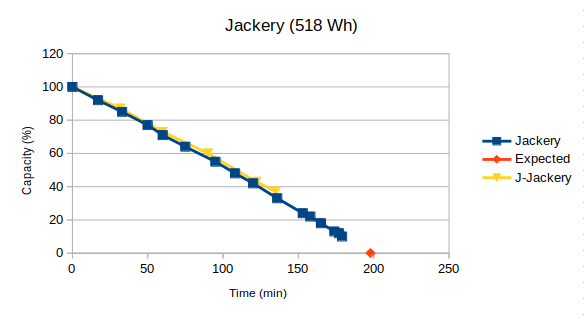
Power usage on the Jackery Explorer 500
I was very happy that the power usage curves from the two boxes are so similar. The newer one is marginally better than mine.
(updated: 13 January 2023)
Jackery Explorer 1000 (1002Wh)
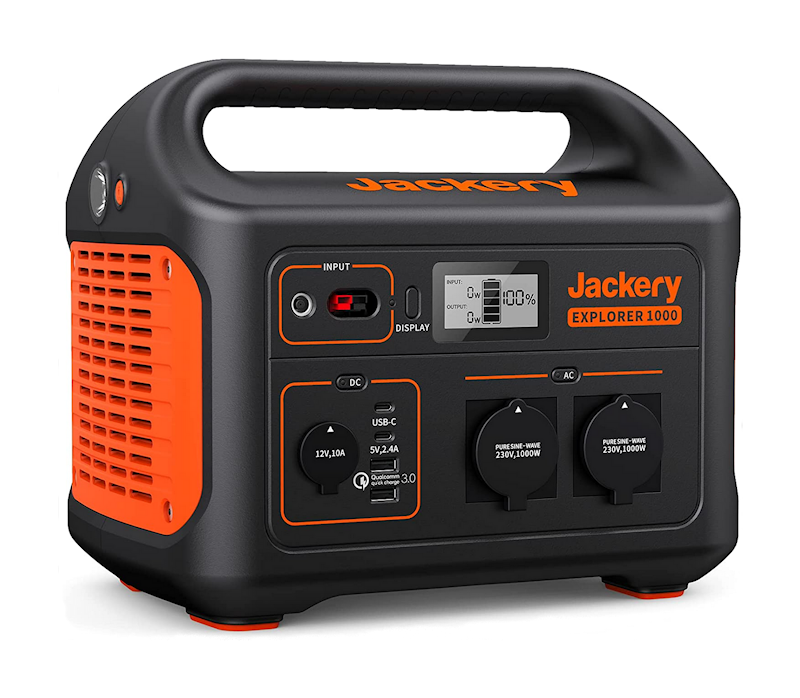
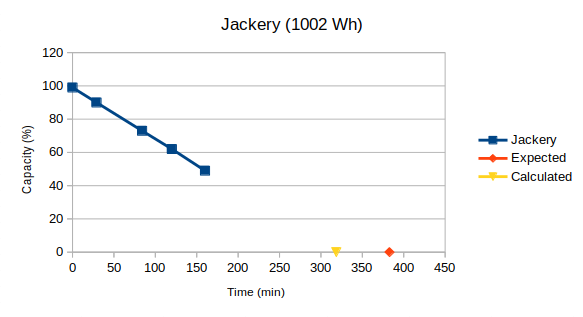
Cara recently bought a Jackery Explorer 1000 and brought it to me to test while we were having a Sunday lunch. Although I couldn't run it down completely in the time we had, I could run it down to below 50% of the capacity.
The Jackery Explorer 1000
Power usage on the Jackery Explorer 1000
Results
As all the boxes I have tested thus far show very linear usage curves, and the data I collected on this box was also linear, I used a linear least squares fit on the data to calculate when the battery would run flat.
- Expected run time: 6.4h
- Calculated run time: 5.3h
- 83% of rated capacity
One thing I did notice, was that this box showed a very much higher power usage on my test system than that given by my power meter (177W as opposed to 157W). I am not sure whether the box's meter was out, or the electronics of the inverter were using more current than any of the smaller capacity boxes.
I was happy that this box could run my kitchen fridge with no problems. All the smaller boxes switch off when the fridge's compressor starts up.
The Jackery 1000 has a 180W power brick (spec from TechRadar), which should help with charging the larger battery. It also has a red/black Anderson port which can take 200W of solar input. It comes with an adaptor which can take 2 Solar Saga 100 panels. I am not sure whether it supports dual charging with solar and AC.
Update (22 November 2022) As the Jackery 1000 can be charged from two Jackery Solar Saga 100 panels, Cara brought her box and panel around and we added my panel to see what kind of power output we could get from two panels. When we set everything up, the panels put out 91W and 89W individually, through the adaptor. As expected, this dropped to 74W as soon as the panels warmed up. What was extremely disappointing was that the two panels together only produced 113W. This means that the box would take almost 9h to charge from solar, from empty. Jackery claim that the box should charge within 6.5h from two panels.
For the extra 40W, it's hardly worth spending an extra R7000 on a second panel.
(updated: 22 November 2022)
Bluetti EB70 (716Wh)
With the amount of load shedding increasing, we decided to look at a device which has a higher capacity than the Jackery Explorer 500 (and would not break the bank) which could also run the kitchen fridge. Pat happened to pick up a video from Jasonoid on Youtube covering the EB70 and the EB70 available locally happened to have a decent enough price on Takealot. A plus to this was that the inverter had a 1kW output which could handle a 1.4kW spike (the one Jasonoid tested only had 700W output), so I decided to buy it. A further point in its favour was that it also has a LiFePO4 battery which as I mentioned earlier, I am very keen on having.
The EB70 comes with an 8mm male plug to MC4 adaptor for solar input.
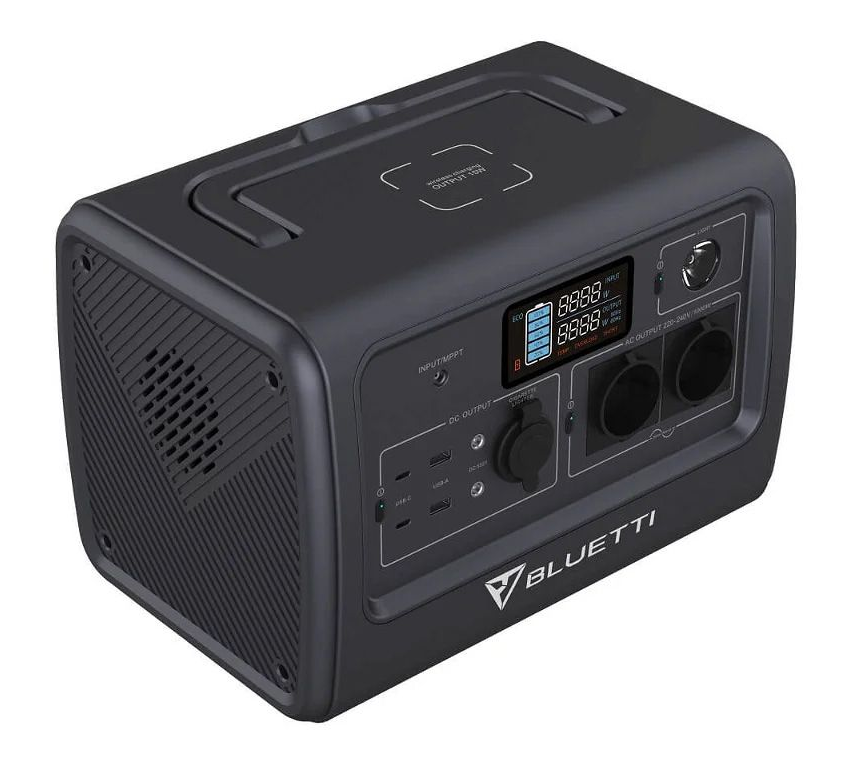
The Bluetti EB70
As the device has an 8mm (DC7909) barrel connector input socket I was hoping that I could use the Jackery panel and extension cables without an adaptor. Of course, the first thing I tested after unboxing was not the output from the device, but rather the input from the solar panel. I am happy to say, that the Jackery plugs all worked without a hitch.
As other reviewers have mentioned, the display is rather primitive, but nowhere nearly as bad as the Gizzu mentioned above. At least it does show the input and output power levels. I am not sure how accurate these are as with my test system, the EB70 showed a usage of 148W, not the 157W shown by my external power meter. The lack of a dedicated display button is also irksome to some reviewers. I have found that if you do a quick press on the lamp button, while the box is doing something (charging or discharging), the display will switch on for about 30s (and not the lamp). If the box is idle, the lamp and display will switch on. To switch the lamp on while the box is doing something, long press its button.
Before running my test, I charged the box to 100%, to see the idiosyncrasies of the charging system. All reviewers do complain about this. As the power brick can supply 200W of charging power, it has a built-in fan which runs continuously while it is connected to the mains. The complaint is that this fan is very noisy, but it is probably as loud as a kitchen fridge when the compressor is running. Another difference to other power boxes is that the EB70's fan also switches on during AC charging. The sound of the two fans together do make quite a bit of noise. One thing I must say though the EB70's fan is nowhere near as loud as that of the Gizzu. (Also, during my testing session, which was more than four hours running my test system, the EB70's fan did not switch on once, which is different to all the other boxes I have tested.)
In order to get figures to be able to draw the graph, I had to use a similar tactic to the one I used for the Gizzu. For my 157W load, at 100% efficiency, I should lose a bar every 55 minutes and at 80% efficiency, I should lose a bar every 45 minutes, so I started checking the display regularly after 35 minutes elapsed. To my dismay, the first bar had disappeared after only 41 minutes, which looked as though this box might also have to be returned if the linear usage curve, shown by the other boxes, was followed. Fortunately, this was not the case, as you can see from the graph below.
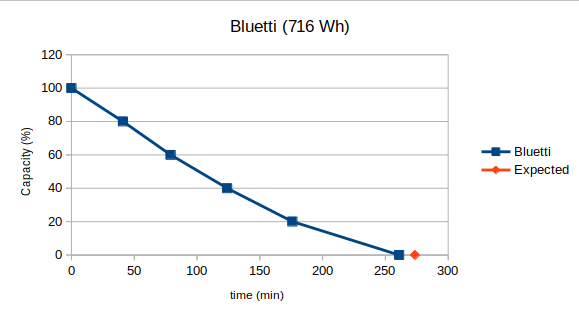
Power usage on the Bluetti EB70
Results
As you can see, the curve is not linear as with the other boxes, but looks more like an exponential decay curve, which is rather strange. The shape of the curve is dominated by the last two points - the second last, which corresponds with the 52 minutes the second last bar on the graph on the display (20-40%) took to disappear and last one (0-20%) took 85 minutes.
- Expected run time: 4.56h
- Achieved run time: 4.35h
- 95% of rated capacity
==//==
The EB0 runs my kitchen fridge with no problems.
Some numbers regarding charging from empty:
- the power brick draws ~230W while charging the EB70, which showed 181W going in;
- after charging for 4h42m the EB70's fan switched off and the charge going in dropped to 18W;
- at the same time the power going into the power brick dropped to 55W;
- the power going into the power brick decreased steadily down to 8W after about 8 minutes (8W is the power consumption of the power brick with no load);
- total charge time 4h50m.
The fan in the EB70 switching off during AC charging is an indication that it is close to being fully charged.
The EB70 took more than 5 hours to charge from the Jackery Panel, starting in the 40-60% range. There were intermittent clouds early on, but changing the orientation of the panel regularly did help in maximising the power to the EB70.
I have since purchased a Bluetti PV200 panel (200W), and the charging time, starting in the 40-60% range, is 3½h, which is appreciably quicker than when using the Jackery panel.
Using this panel I found that the EB70's fan switches on with around 85W of power (EB70's meter) going in to the EB70.
An interesting thing I found during an extended power outage was:
- The EB70 can run AC and DC simultaneously (running the kitchen fridge and charging mobile devices);
- The EB70 can be charged with a solar panel while using AC (running the fridge);
- The EB70 can be charged with a solar panel while using DC (I knew this from running the camping fridge - see below);
- However, the EB70 cannot be charged with a solar panel while using both AC and DC - it immediately gives an overload error and shuts down.
Update (1 November 2024) I was hoping to be able to run the pump, which came with my JoJo installation, with the EB70, but unfortunately it was unable to do this. The pump is rated at 750W which is well within the EB70's specs (1kW), however, I found the pump drew 936W. This is also within the EB70's specs, but it could not run the pump, probably due to the startup surge from the pump.
(updated: 6 June 2023)
Recommendations
I have been asked to make recommendations on what I think is worthwhile buying from a South African perspective. These are my thoughts.
Ecoflow River Max (576Wh) If this device's battery performed up to rated value, I would have no qualms in recommending it, in spite of the price. The direct AC input, with the UPS functionality, and the fast charging with the Ecoboost system would make buying this an absolute no brainer. If you use this device under the conditions that you would normally use it for (not trying to burn it out with a heat gun), then it would be a must have.
Gizzu GPS500 (518Wh) If you are on a tight budget, then this is the device worth buying. If you watch the prices, you can still get it for under R7000 - Mike got one for R6999 by doing just that. My biggest gripes are the slow charging time and no adaptors for solar charging. This device performed very well during the serious load shedding in June and July of 2022.
Jackery Explorer 500 (518Wh) To me, this device is totally overpriced. However, it does have all kinds of accessories available in SA (even if these are also overpriced). Because of the availability of these accessories, I would still recommend buying one of these boxes. Everything works, and the response from the SA support team is absolutely top notch. My biggest gripe, is the slow charging time - it is faster than the Gizzu though.
Bluetti EB70 (716Wh) The display is the only problem that I have with this device. The 95% usable power that I can get from the battery when running AC makes this the best of the smaller boxes available in South Africa. This box, together with the Jackery 500, gives me 1152Wh of usable capacity for R25949, whereas the Jackery 1000, with a usable capacity of 831Wh, costs R24950 (prices 17 May 2023). A feature that must not be overlooked is that the Jackery extension cables for charging can be used without adaptors.
(updated: 17 May 2023)
Price Gouging
As I mentioned above, with the mini-ups and the Gizzu, the suppliers are milking the market with the current round of load shedding. Jackery upped their prices by R1000, and Outdoor Warehouse followed suit (even though there was no way they could have sold all the boxes in stock in the couple of weeks after I bought mine). They (Outdoor Warehouse) also upped the price on the Red-E by R1000 in the same period.
Update (28 December 2022) It looks as though the South African media have finally realised that price gouging on these devices is real. In June this year, I paid R6500 for the Gizzu 518 box. As mentioned above, I called price gouging when the price went up to R8500 in the space of one month. The seller really outdid him/herself in December 2022 when the price hit R16000. This is more than double the price I paid. Fortunately, this was picked up by Takealot, who suspended the seller. Daily Maverick reported on this (unfortunately, Daily Maverick has nagware blocking the article on occasions. You can close and reopen the article, or I can send you a link to a pdf).
Camping Fridge
Recently, Makro had a special on the 75L Snomaster dual compartment fridge from their Leisure Series range. We bought one of these units, and tested it with both the Jackery and the Gizzu. On AC, the fridge drew 75W in the MAX mode, and 24W in the ECO mode. I set the one compartment of the fridge to -10°C and the other to 4°C and let the fridge cool down to these temperatures on AC in MAX mode. After this, I ran it on ECO mode using the Jackery and the Gizzu for 24h each.
I was happy enough that the Jackery ran the fridge for the 24h with 24% charge remaining on the battery. The Gizzu looked like it was actually doing better than the Jackery, but it died after exactly 24h. This means with the two boxes, I can run the fridge indefinitely, providing I can charge one box while using the other to run the fridge.
What a nice thought - having cold beers after three days of camping!
Portable Solar Panels
In order to be able to camp off grid, we needed to be able to recharge the power box. For this, we decided to look at a portable solar panel.
I have done some tests on running the camping fridge with the Jackery power box and the solar panel. These were very positive.
(updated: 4 October 2022)
Charging the Jackery 500 from the Bluetti EB70
This exercise was part of my camping tests - I wanted to see how efficiently the Bluetti could charge the Jackery. As the Jackery is very much lighter than the Bluetti, I would rather use it to run my fridge than the Bluetti, as it is easier to move around.
I ran the Jackery down to 61% of its capacity, then charged it from the Bluetti using the car charging cable. I was pleasantly surprised to find that the Bluetti put out 85W to the Jackery (Jackery's meter). This is 1W less than the power received from the Jackery's AC power brick. Charging time was about 3½h which is acceptable. During this charging cycle, the Bluetti lost two bars on its capacity meter, which is also acceptable.
One thing I did find was that the Bluetti's output meter showed 77W going out during this exercise, which is lower than the Jackery's 85W going in. This reinforces what I said earlier, that the Bluetti's meter is not very accurate.
A problem that I did hit during this test is that the Jackery's car charging cable did not work (this was the first time I tried it). The Bluetti's one worked fine. Here I have to give kudos to the Jackery support team. I contacted them (by email) on a Friday morning, and by early the next Wednesday morning a courier delivered a replacement - Jackery ZA's support is absolutely top notch.
Update (14 September 2023) I did a field test of this on our trip to Almega Caravan Park. With the Jackery running the fridge, I used the EB70 to charge the Jackery once it got to around 60% capacity during the day. At the same time, I charged the EB70 with the PV200 panel. During the night, the Jackery ran the fridge without being charged. During the four day trip (home to home), the Jackery never dropped to below 40% of its capacity. The EB70's residual capacity also remained in the 80-100% range during this period. I am very happy with this setup.
(updated: 28 June 2023)
