Portable Solar Panels
Introduction
Part of our new camping requirements, was to have a fridge, and, more importantly, to be able to power this fridge. Camping fridges are quite pricey, so we were wary of buying. What we were looking for was something in the 50 to 60 L range, with a separate fridge/freezer compartment with two lids. These devices at the moment are priced between R12000 and R15000 - to justify this, we would have to camp more than 10 times per year, which is not quite feasible. Recently, Makro had a special on the 75 L Snomaster dual compartment fridge from their Leisure Series range at under R10000. Although this device was bigger than what we wanted, we decided to buy it as it could serve as an emergency backup freezer - we do have extended blackouts, other than load shedding, due to cable theft and power distribution problems.
In our tests of portable power supplies, we had decided that the Jackery was the best of the bunch as it actually delivered what it was supposed to. From these tests, the Jackery 500 power supply ran the fridge for 24 h, with 24% of the battery capacity remaining. What we now needed was something to power the Jackery, while we were not driving. This meant looking at solar panels.
The problem with solar panels is that the peak efficiency of the panels never meet up with the rated efficiency. For instance, the Jackery Solar Saga 100 W panel delivers, at best, around 90 W of power (according to the learned people on YouTube). What I was after was a panel delivering something closer to the 100 W that the MPPT controller in the Jackery is supposed to handle. A panel that was marginally more expensive than the Jackery panel, that was readily available was the Enertech 130 W Solar Panel. From all my research on the Interwebs, a panel with this output should easily deliver the 100 W that I wanted.
Please note that nothing here is sponsored..
Enertech 130 W Panel
During our visits to the Outdoor Warehouse store, we looked at the Enertech panel. I liked this panel because of its higher output rating. Other factors in its favour were the Anderson plug on the output; an MPPT control module; and a 10 m extension cable. With other panels, one or more of these were extras.
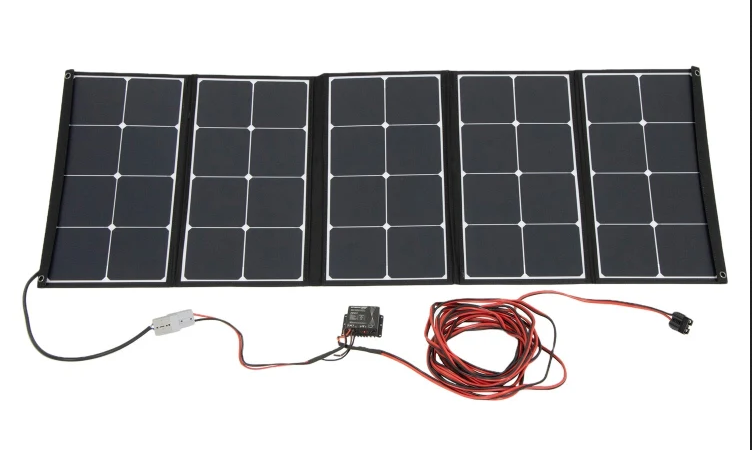
The Enertech 130 W Panel with accessories
The Outdoor Warehouse website has two versions of the panel (with identical specs) available, with a R1000 price difference between them. In-store sales people did not know about these differently priced panels. Only the more expensive version was available in the store. To me, it was a no-brainer to go for the cheaper panel.
The device has five smallish panels, with four of them having a stand. The fifth panel has a zippered bag for the cable from the panel. The cable has a grey Anderson connector to connect to the MPPT controller. The output from the MPPT controller has a red Anderson connector which connects to the extension cable. The other end of the extension cable has another grey Anderson connector. In order to connect to the Jackery battery box, I had to purchase a grey Anderson to 8 mm barrel plug adaptor.
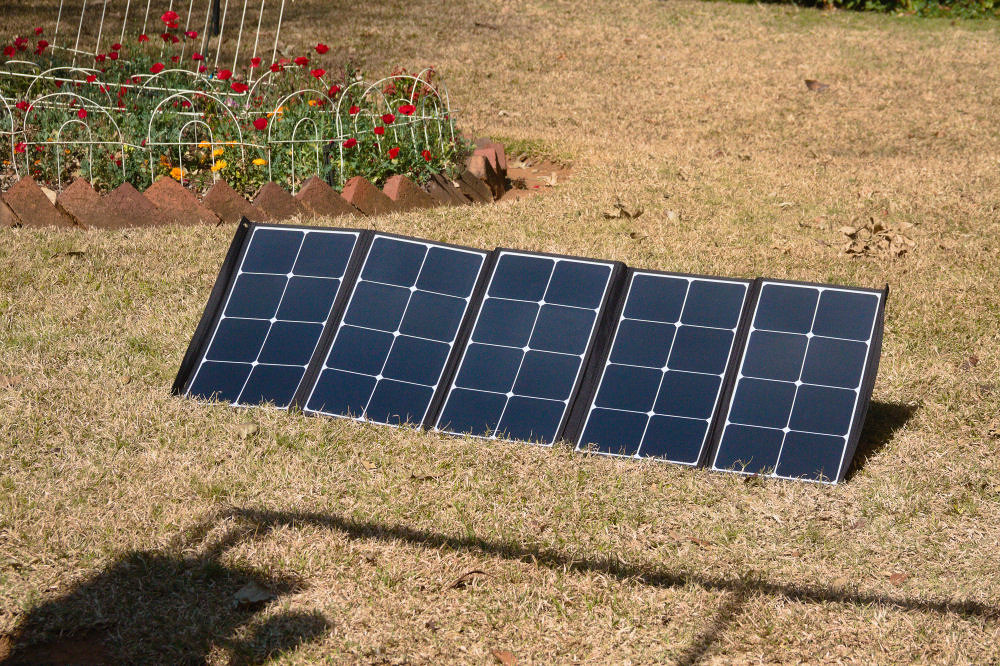
The Enertech 130 W Panel in my garden
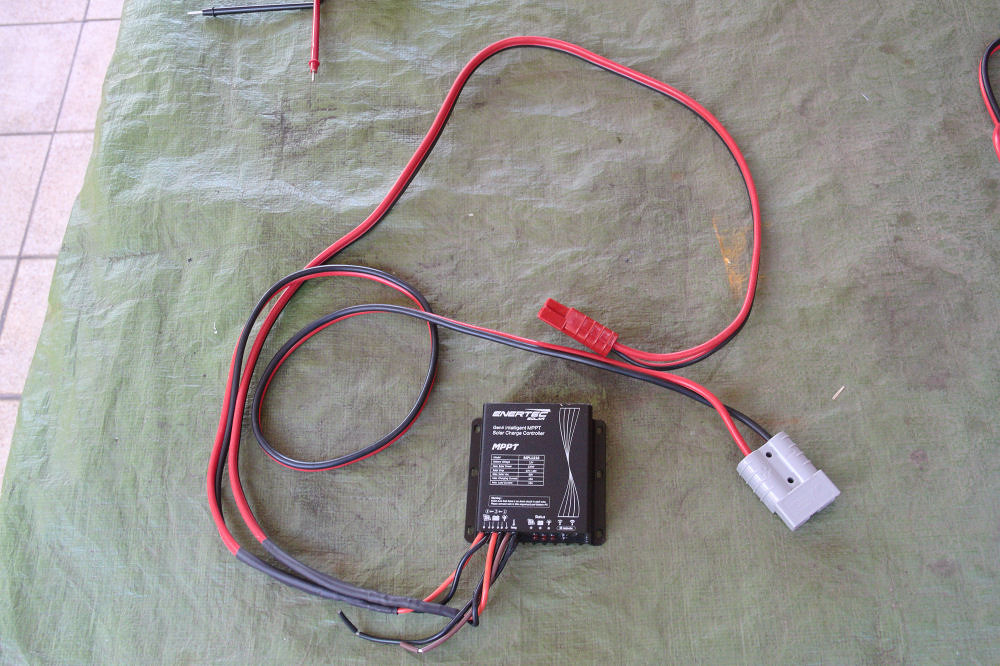
The Enertech 130 W MPPT controller with cables
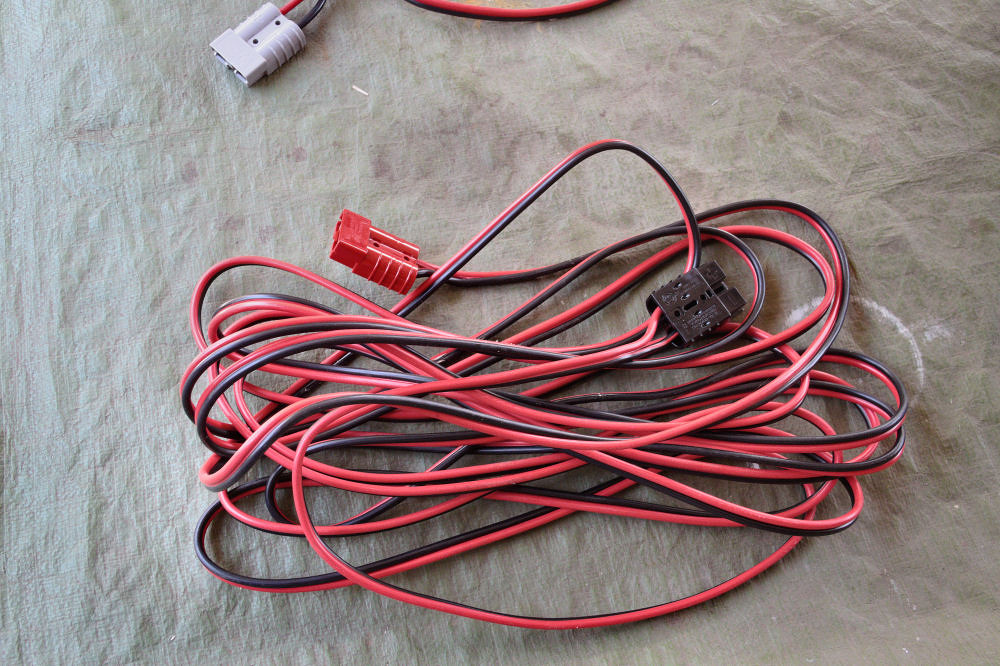
The Enertech 130 W panel's extension cable
According to the blurb on the Outdoor Warehouse product page, the extension cable is supposed to be 10 m, however, I don't think it was more than 8 m. It was included as part of the package, so I won't quibble about that.
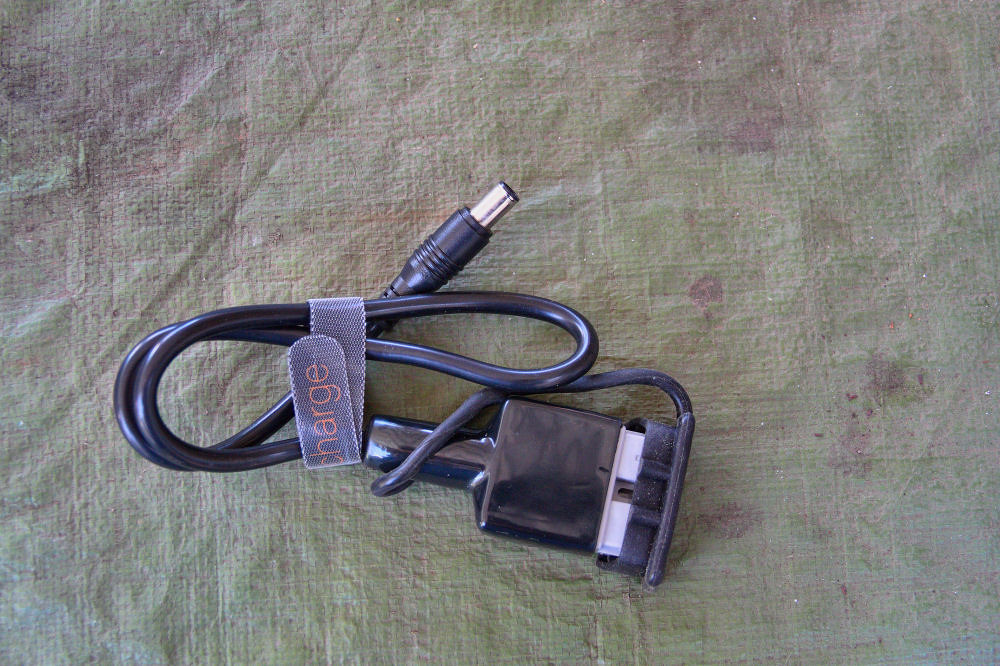
An EvoCharge adaptor cable from Anderson grey connector to Jackery 8 mm barrel plug
Unfortunately, the MPPT controller was dead-on-arrival - a flashing red light on the output port, and an output of 1.2 V rather than the expected 24 V. The Jackery battery box does have a built-in MPPT controller, so I could plug the Jackery's adaptor cable directly into the grey Anderson connector on the output from the panel, to do some tests. This was not optimum as I had to keep the Jackery battery box in the shade of the panel.
The panel had to be rotated at regular intervals to maintain an optimum power output to the Jackery power box. The best I got was 83 W, but this was only briefly. It seemed to hover between 57 W and 62 W most of the time, far off the rated 130 W.
I decided to return this panel. Fortunately, Outdoor Warehouse have a similar return policy to Takealot, so I had no hassles with the return. Instead of waiting for a replacement panel or taking a refund, I decided instead to go with a Jackery SolarSaga 100 W Panel.
Jackery SolarSaga 100 W Panel
The Jackery SolarSaga 100 consists of 2 Panels, each with a stand. One panel also has a bag on the back for the 3 m cable attached to the panel. This cable terminates in an 8 mm (actually a DC7909) barrel plug to connect to a Jackery power box. The output from the panel also has two USB ports for charging compatible devices. I am not sure how useful these ports are, as I certainly would not like to have a phone charging in the blazing hot African sun.
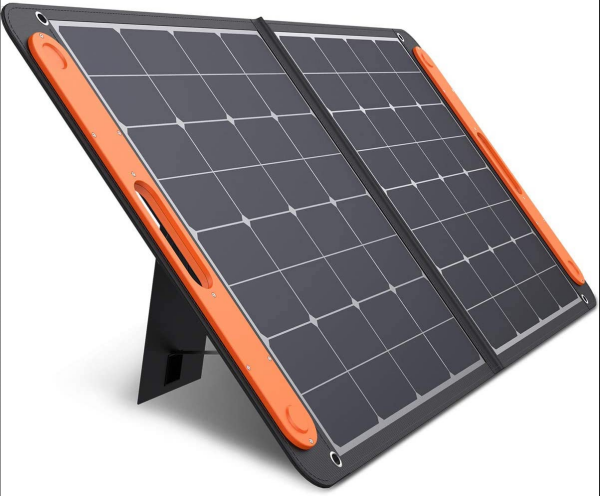
The Jackery SolarSaga 100 W Panel
The 3 m cable is way too short, so I had to purchase a 5 m extension cable. Fortunately, Jackery has the market covered for accessory cables (and third party cables, from companies like EvoCharge, are also available - pdf brochure).
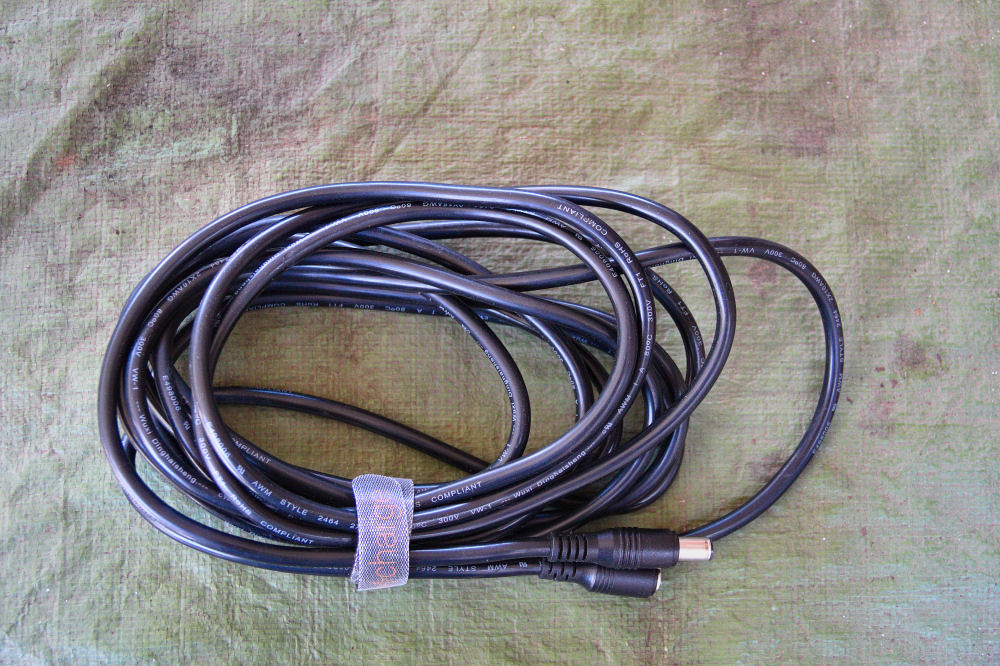
An EvoCharge 5 m extension cable
The 5 m cable is also too short for my needs, but I am not sure what the voltage drop would be with a second 5 m cable (and the extra connectors) added.
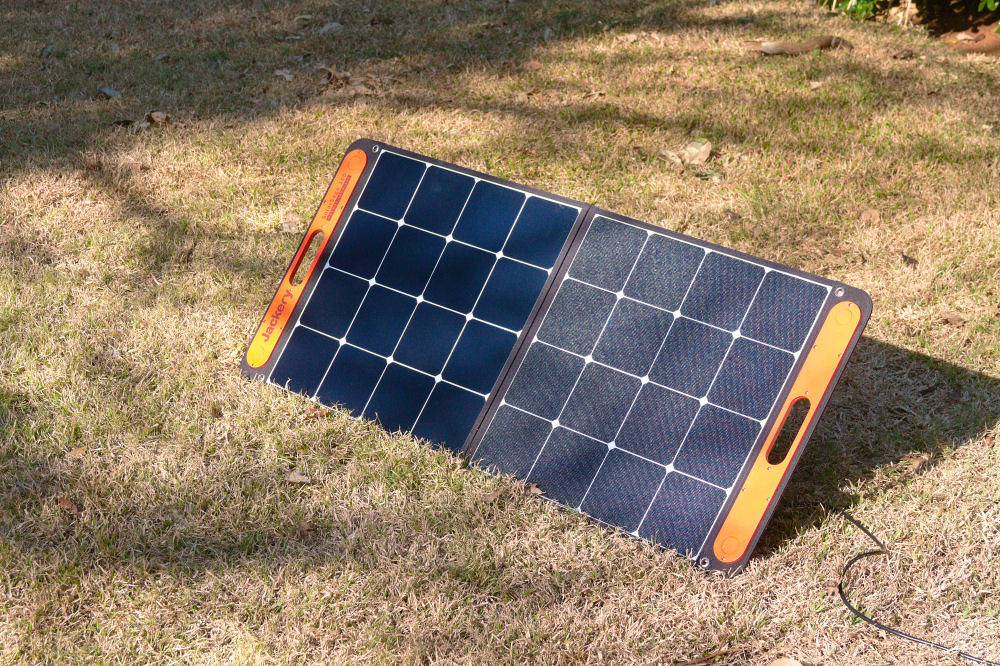
The Jackery SolarSaga 100 W Panel in my garden
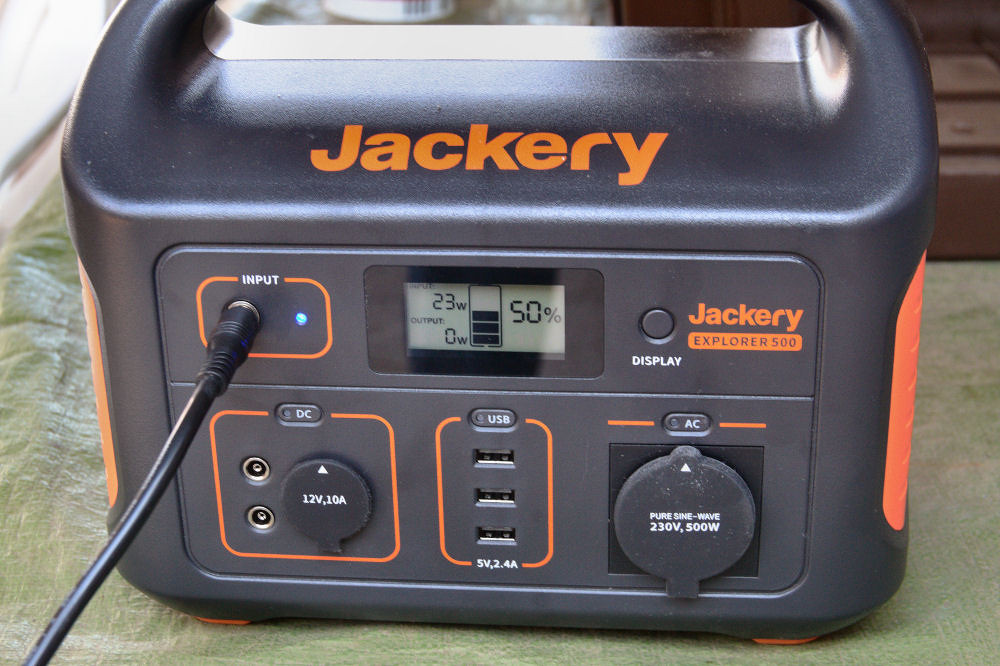
The Jackery Explorer 500 being charged from solar
The two preceding images were recorded at the same time. As you can see, I was getting a dismal 23 W output from the panel. However, if you look at the picture of the panel, you can clearly see that the shadows from a tree is clearly interfering with the solar input to the panel. Moving the panel to a different location, increased the output to 75 W, which settled down to 72 W.
(updated: 28 June 2023)
As I have had the Jackery panel longer than the Enertech panel, I have had more time to test its capabilities. One of my major findings was that the placement of the panel, relative to the sun, had a huge impact on the output from the panel. I did hit a 93 W output from the Jackery, but I am not sure how reliable that was. Under optimum conditions, between 67 W and 75 W was the best I could achieve. This did require moving/rotating the panel regularly.
I have collated a lot of numbers with regard to the efficiency of the panels. There are, however, too many variables involved to be able to show any meaningful graphs. The most critical factor is the alignment of the panel with the sun - you want to have the panel as close to a right angle with the sun's rays as possible to achieve maximum output from the panel. The angle of the panel to the vertical also plays a role. Most of the portable panels available have a fixed angle - with the "movement of the sun" during the seasons, the optimum angle will change.
So, the efficiency of the panel is very dependent on the angle at which it faces the sun. As a result, with fixed panel systems, such as with most home systems, you have to over-panel the solar system to get a decent current throughput to the batteries. If I was looking at a fixed panel system, I would love to be able to include a sun tracking panel adjustment system. This should decrease the number of panels needed to achieve the required current output.
I really would have liked to have had more time to test the Enertech panel, but unfortunately, a DoA link in the system does not inspire confidence.
(updated: 19 August 2022)
Bluetti PV200 Panel (200 W)
With the purchase of the Bluetti EB70 power supply, we decided that we needed a panel with a higher output than the Jackery SolarSaga Panel. The 100 W maximum power output would take too long to charge the EB70 in a solar day. With the Bluetti PV200 being on special on Takealot at an appreciable discount, we decided to buy it (in spite of a R200 bulky item surcharge, but that is another story).
The PV200 is quite a bit heavier than the SolarSaga 100 (7.3 kg vs 4 kg). It consists of four panels, three of which have stands. Because of the four panels, it is quite difficult to move, to track the sun, when compared with the SolarSaga Panel. One of the panels has a bag for the cable which is big enough to leave an adapter cable attached.
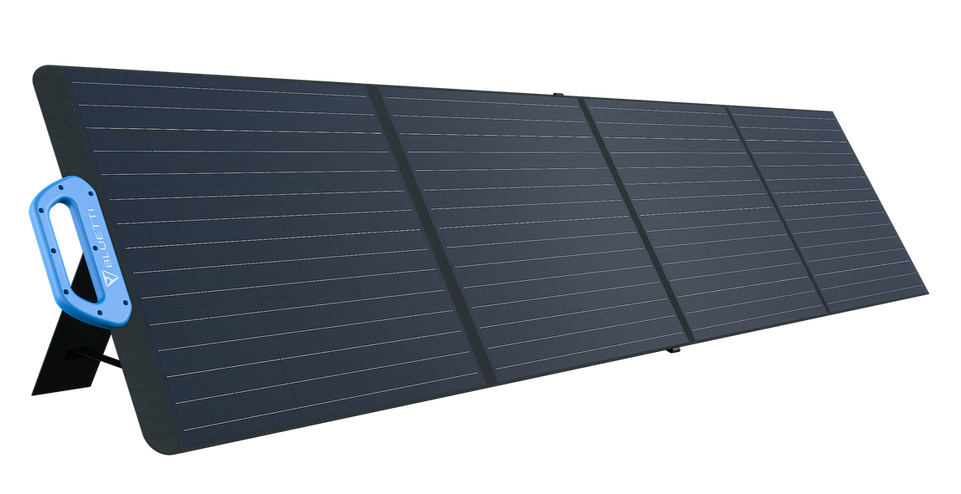
The Bluetti PV200 Panel
The stands are adjustable, which allows some leeway in setting the angle of the panels relative to the sun.
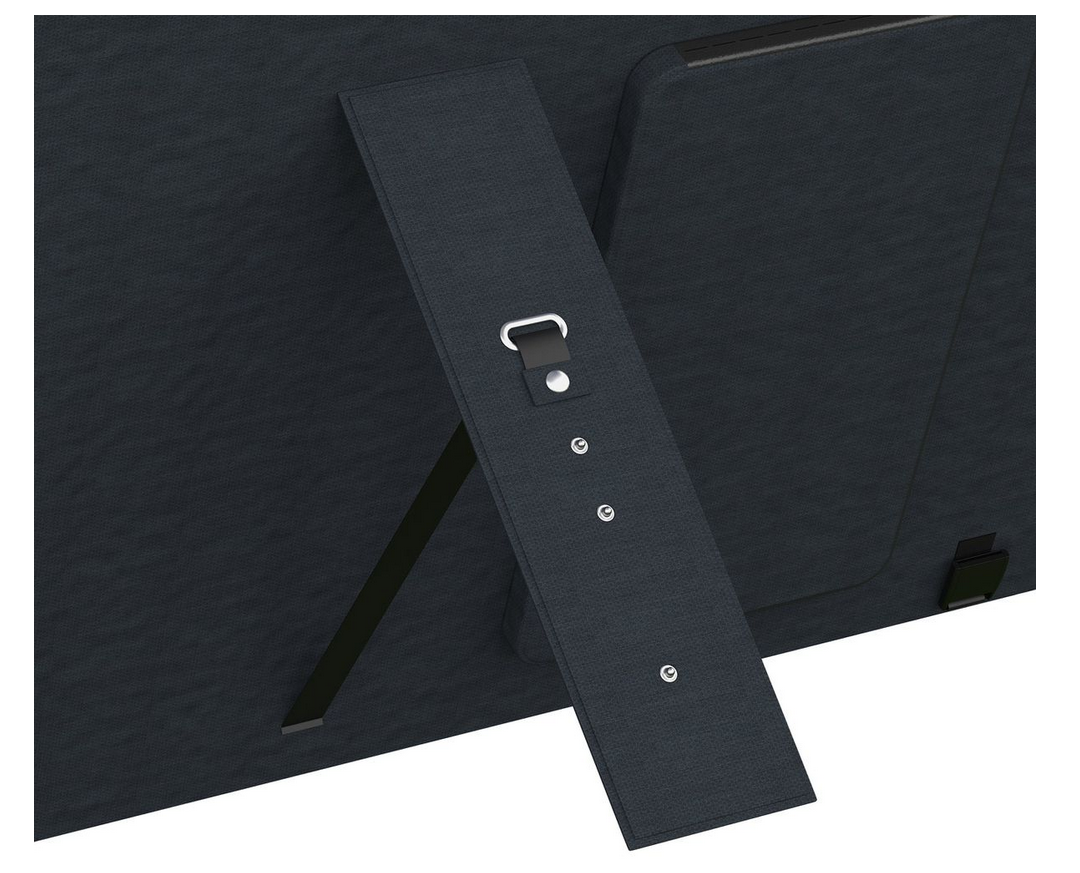
One of the Bluetti PV200's stands
The panel has MC4 connectors, but there is an adapter cable (MC4 to DC7909) that comes with the EB70. The panel's cable plus the adapter cable is about 4 m (every bit helps). I could buy an MC4 extension cable, but with the adapter, I can still use the Jackery's extension cables.
During the first test, the EB70's charge level was between 40% and 60% (third bar flashing). With misty sun to start, followed by periods of intermittent heavy cloud, the panel managed to top up the EB70 within 3½ h. The best output we saw (according to the EB70's input meter) was 160 W.
One thing that I don't like about the panel is the fastening system. The two push clips really do not feel sturdy at all. Jackery's magnetic clips work much better, but I don't think that would work on a 4 panel setup like the PV200
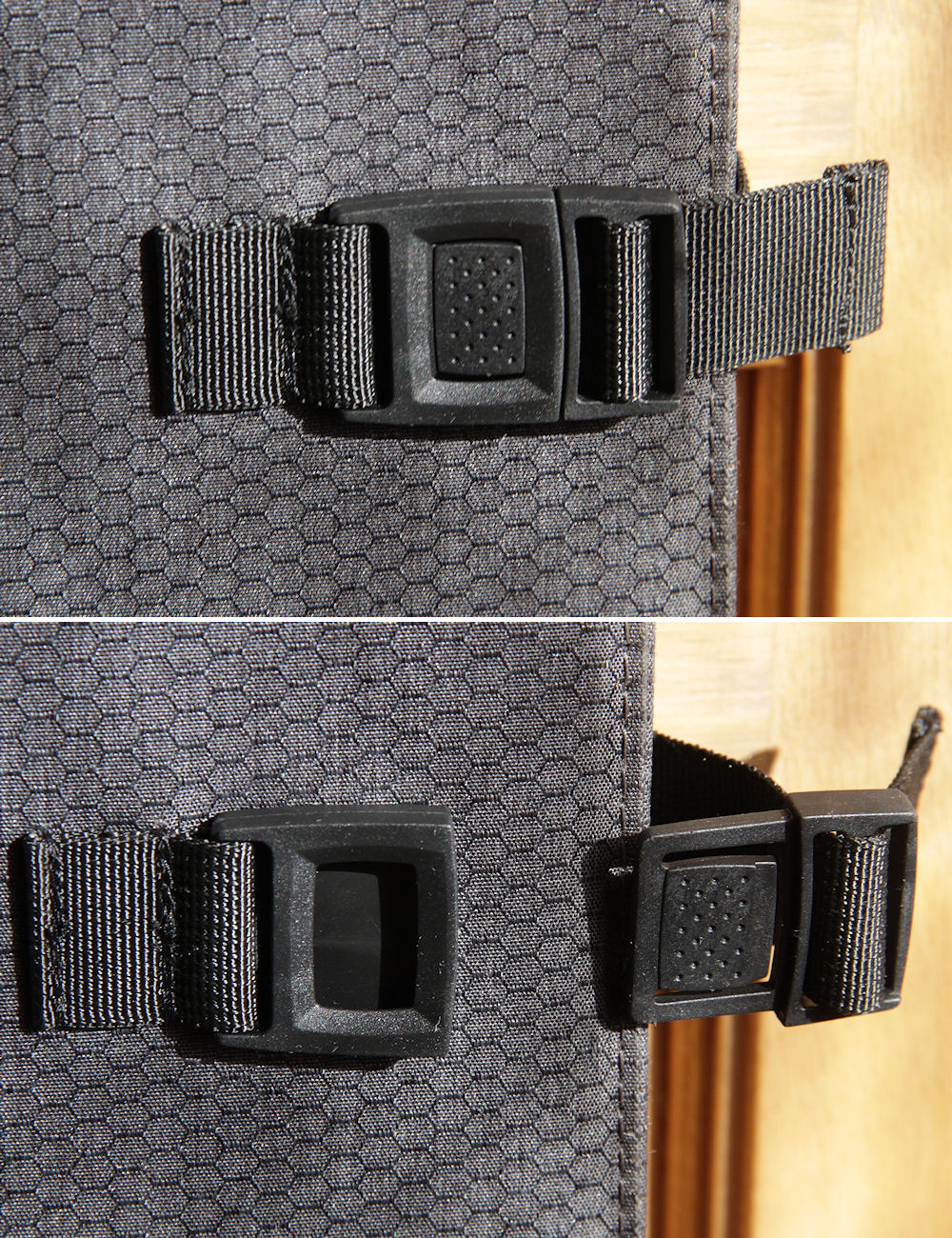
One of the PV200's two clips
Something that worries me is that the panels have to be folded in such a way that the panel without a stand is on the outside (to show the Bluetti branding). This means that one (or more) studs on the stand are in contact with the face of a panel. This could scratch or damage this panel.
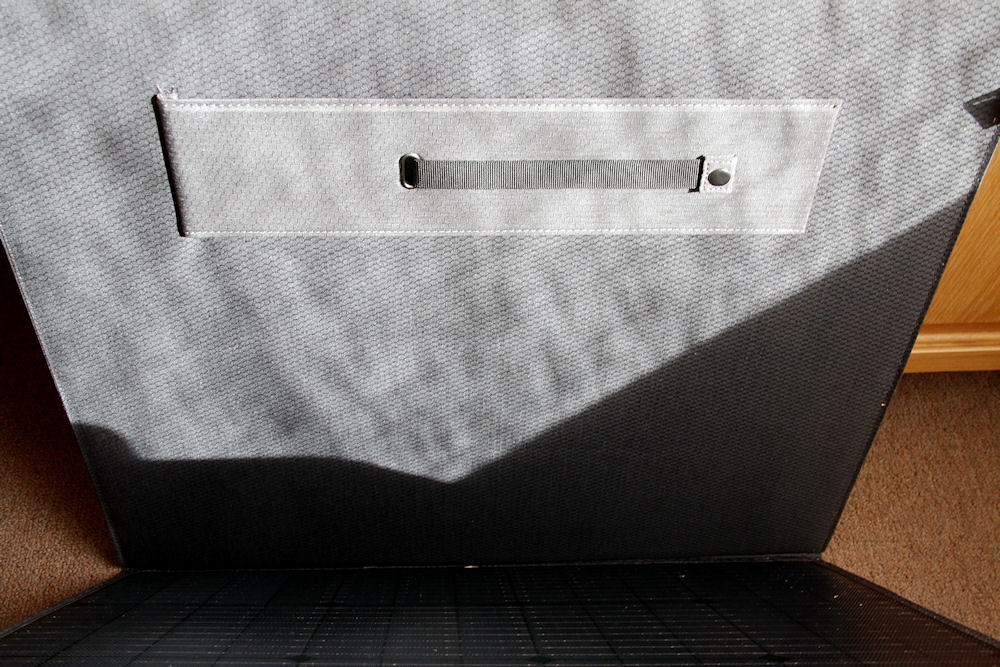
A stud in contact with the panel.
Folding the panels in a zig-zag eliminates this problem, but then the clips to close the panel don't work.
There are also no grommets, so you have no way to tie the panel down in windy conditions (Pat has since made a gadget to tie down the stands of the panel).
I have added a page to try and demonstrate the easiest way I have found to open the panel (and close it).
(updated: 29 August 2023)
Update
I have had the chance to do a more serious test with the Jackery 500, the Jackery solar panel and the Snomaster camping fridge. Snomaster recommends running the fridge for a couple of days every month to ensure the gas circulation is working properly. I did this over the last weekend, but here, I decided not to use grid power at all. I used the Jackery 500 to run the fridge, and the Jackery solar panel to charge the box while it was running the fridge, during the usable sunlight hours. I was pleasantly surprised by my findings. For the test, the fridge compartments were set at -10°C and 4°C, respectively.
With the panel connected to the power box, I started off by running the fridge in MAX mode until the freezer compartment reached 0°C, then switched to ECO mode. At this stage, the available battery capacity had dropped to 97%, which I thought was really good. During the course of the day (with the panels not being in an optimum position), the available battery capacity hovered around 99%.
Overnight, the available battery capacity dropped to 49%, which is in line with my earlier tests with the fridge running from the Jackery 500 (50% net loss).
During the course of the day, I tried to find decent placement for the panels, but by the end of the solar day, the battery only reached 84% of its available capacity (35% net gain).
As expected, this dropped to 38% overnight (46% net loss).
For the third day's test, I decided to move the whole system to a far better position from a solar energy input point of view. By the end of the day, the battery had reached 82% of its available capacity (a 44% net gain).
From these simplistic tests, I am sure that with optimum solar conditions, I could run the fridge with only solar input to top up the Jackery, for at least a week.
(updated: 30 August 2022)
Update: Temperature Effects
I have found from many hours of using the Jackery panel, the efficiency of the panel decreases as the panel gets warmer. Immediately after setting up the panel, it delivers between 75 W and 80 W. Within 15 minutes, this drops to between 70 W and 72 W and after another 15 minutes, this then stabilises at between 67 W and 69 W. This value remains fairly constant with regular rotation of the panel to track the sun.
As this is panel is rated at 100 W output, an input to the Jackery Power Supply of 67 W means an efficiency of 67%.
Interestingly enough, the Bluetti PV200 shows very similar temperature characteristics to the Jackery panel. On a recent run, I monitored the power decrease with time. On this particular run, the PV200 started at 153 W out (Bluetti EB70's meter reading). After 15 minutes, this dropped to 134 W. Normally the steady state output power from the PV200 is around 132 W.
As this is a 200 W panel, this means the panel efficiency is 66%, which is almost identical to the Jackery SolarSaga 100.
(updated: 18 September 2023)
Update: Shadow Effects
As I mentioned earlier, the Jackery panel is unbelievably sensitive to shadows falling across the cells. The image below is a case in point.
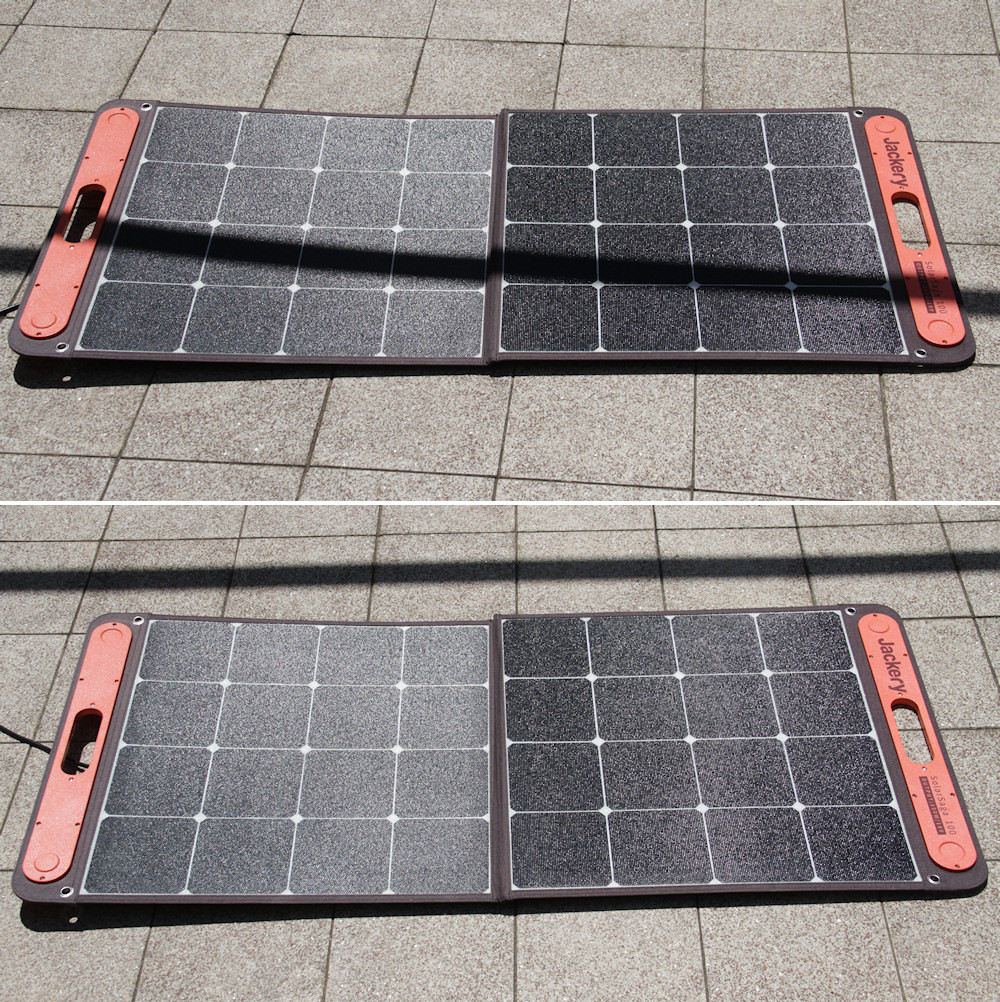
Shadow on the panel
In the top image, the input power to the Jackery box was 43 W. Moving the panel away from the shadow, as shown in the bottom image, the power input jumped to 71 W.
This same shadow effect is even more marked on the Bluetti panel. Exactly one year later, at the same time, I repeated the test on the Bluetti panel.
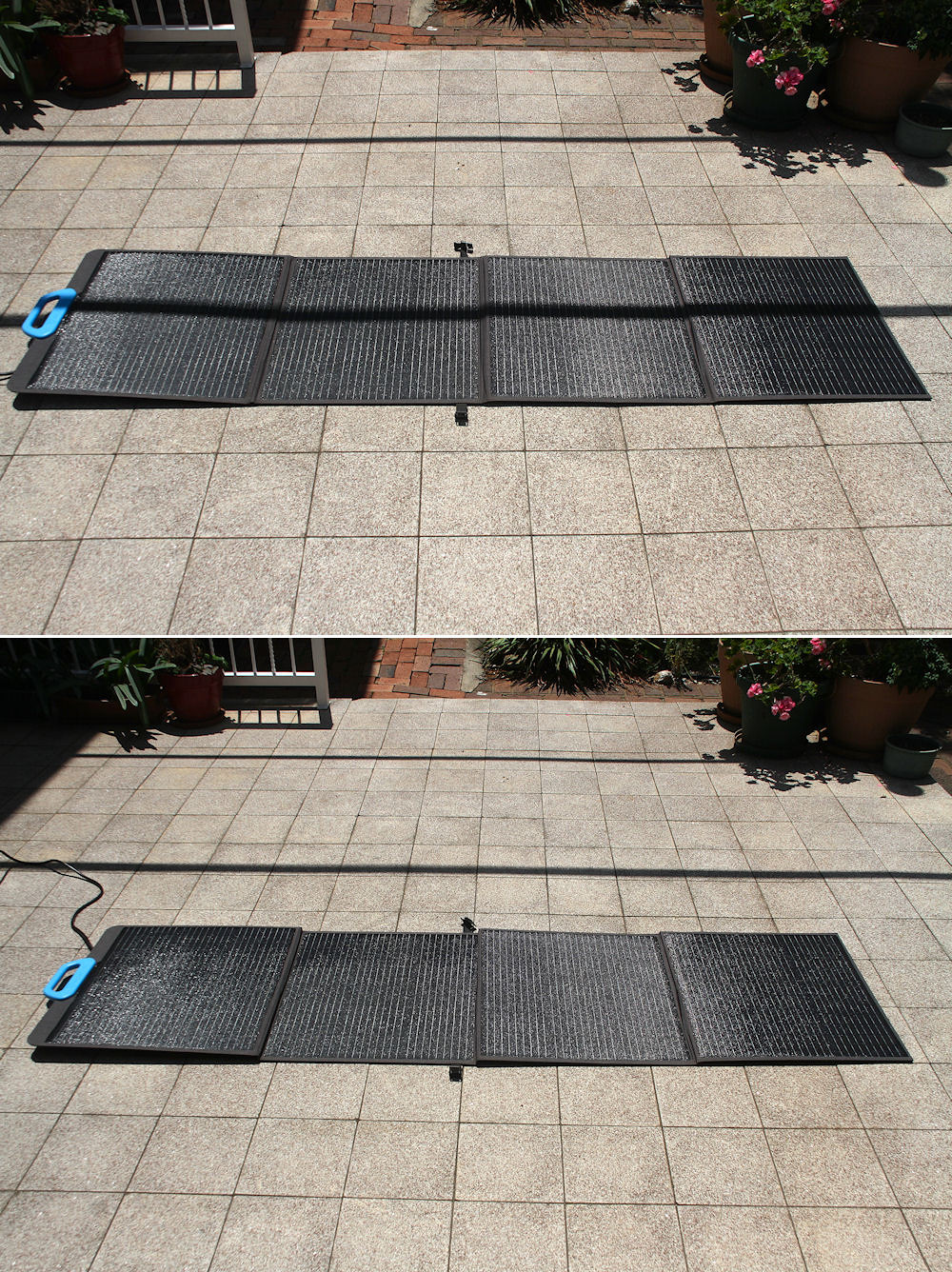
Shadow on the panel
With the shadow across the panel, the output to the EB70 was 39 W. Moving the panel away from the shadow caused a jump to 140 W. A shadow across all the Bluetti panels caused a much bigger power drop (73%) than was the case with the Jackery panel (39%).
Taking this one step further, I covered the Jackery panel with a towel, in half individual panel increments. Covering half of the first panel dropped the power into the Jackery box from 70 W down to 4 W. Covering more of the panel dropped the power down to 3 W. It remained on 3 W even with the both panels covered. This is probably due to UV light leaking through the towel I used in this experiment.
I repeated this experiment on the Bluetti panel expecting the worst after the single shadow test above. I was pleasantly surprised as the Bluetti panel performed far better than the Jackery. Covering the panel in half individual panel increments, the output from the panel dropped as follows from 141 W: 116 W; 115 W; 83 W; 76 W; 45 W; 45 W; 43 W and then down to 4 W for the last panel, similar to the Jackery, showing UV leakage through the towel.
If you compare this with my earlier test, a single shadow across all the panels has a bigger impact than shadows across individual panels.
From this, I would recommend keeping the panel in full sunlight as far as possible. Even small shadows can have a major impact on the power output from the panel.
(updated: 15 December 2023)
Update: Power Drop from Extension cables
My tests here were not too rigourous. As the output from the panels is too variable, I plugged the extension cables into the Jackery's AC power brick and noted the power output on the Jackery's own meter (I don't have a DC power meter). According to this measurement, each cable dropped the power output by 2 W.
In view of my need to have the Jackery quite a distance from the panels when camping, I can live with the drop of 4 W with two extension cables connected.
(updated: 17 December 2022)
Update: Panel output adapters
When buying a box, there are many different types of solar input connectors, and while some follow recognised formats, manufacturers seldom specify exactly what they are using. In practice, this often leaves the user to figure out compatibility by trial and error.
For instance, the input socket on the Gizzu GPS 500 is a 4.8 × 1.7 mm barrel connector — a size that is very uncommon locally and difficult to source in South Africa.
The current trend with larger boxes and panels is to use XT-60 or XT-90 connectors. XT-60 has effectively become the de facto standard, while XT-90 is less common but still used on higher power equipment.
Another trend is to describe the input simply as an “8 mm” barrel connector — Jackery being a notable example. In reality, two different connectors are used depending on the model of the box: DC7909 and DC8020. Both fall under the vague “8 mm” description, but are not interchangeable.
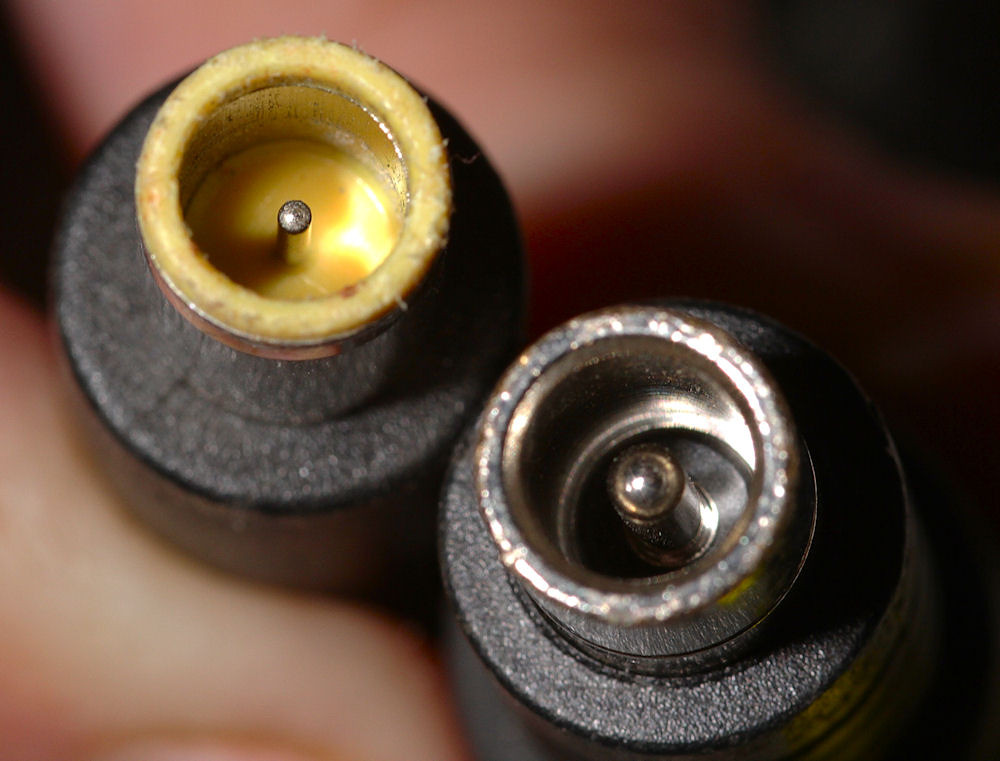
Jackery “8 mm” connectors (DC7909 vs DC8020)
Adapters can be a real issue when buying panels for a specific box. They are not always easy to find, and sourcing the correct connectors for DIY solutions can be equally frustrating.
(updated: 20 April 2026)
